
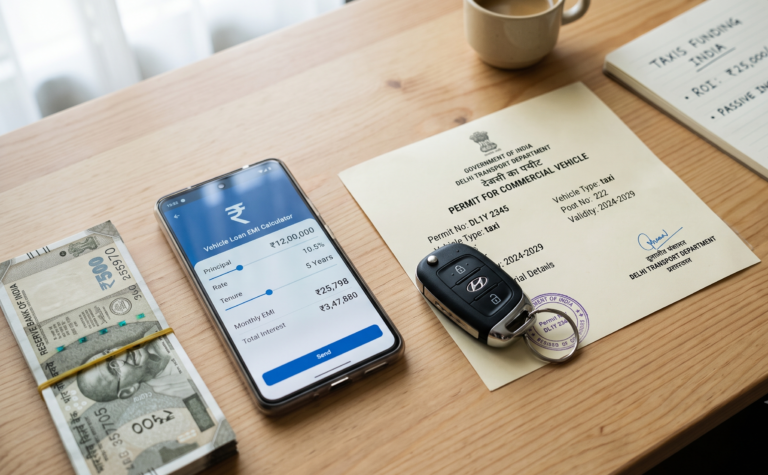
You’ve probably seen the advice on social media:
“Pay a 10% down payment on a car, put it on Ola or Uber, let a hired driver earn the money, pay off the EMI from the rent, and pocket the rest as 100% passive income.”
On paper, it sounds like an effortless financial shortcut. You use other people’s money (the bank) and other people’s time (a driver) to build equity in an asset.
Similar strategies are pitched for two-wheelers: buy a commuter bike for a small down payment, register it on Rapido or Uber Moto in booming cities like Bengaluru or Hyderabad, and generate consistent daily cash flow.
Is financial leverage on vehicles actually that simple in India?
Or does this setup quietly turn into a monthly debt trap once insurance, maintenance, platform commissions, and vehicle downtime hit your balance sheet?
Let’s skip the surface-level motivational talk. Here is an honest, mathematical breakdown of vehicle-based leverage in the Indian market, covering exact costs, real EMIs, hidden liabilities, and the safest way to execute.
1. Active Income vs. Passive Asset: Know the Difference
Before spending a single rupee on a booking advance, you must draw a strict line between two fundamentally different business models:
1. The Passive Fleet Model: You buy the vehicle, pay the down payment and EMI, and hand the keys to an external driver who pays you a fixed daily or monthly rental.
2. The Active Operator Model: You buy the vehicle, pay the EMI, and drive or ride it yourself for 8 to 10 hours a day on aggregator networks.
Most people entering this space believe they are signing up for Model 1 only to realize within 90 days that the margins are too thin to withstand driver defaults or mechanical repairs. To survive, they are forced into Model 2—trading hours for income rather than mastering high-income skills to build wealth with higher upside.
Let’s look at the actual numbers for both four-wheelers and two-wheelers.
2. Case Study 1: The Commercial Sedan (Maruti Dzire Tour / Hyundai Aura)
The commercial sedan is the undisputed workhorse of the Indian cab industry. Here is the realistic capital and cash-flow breakdown for running one on commercial plates (yellow board).
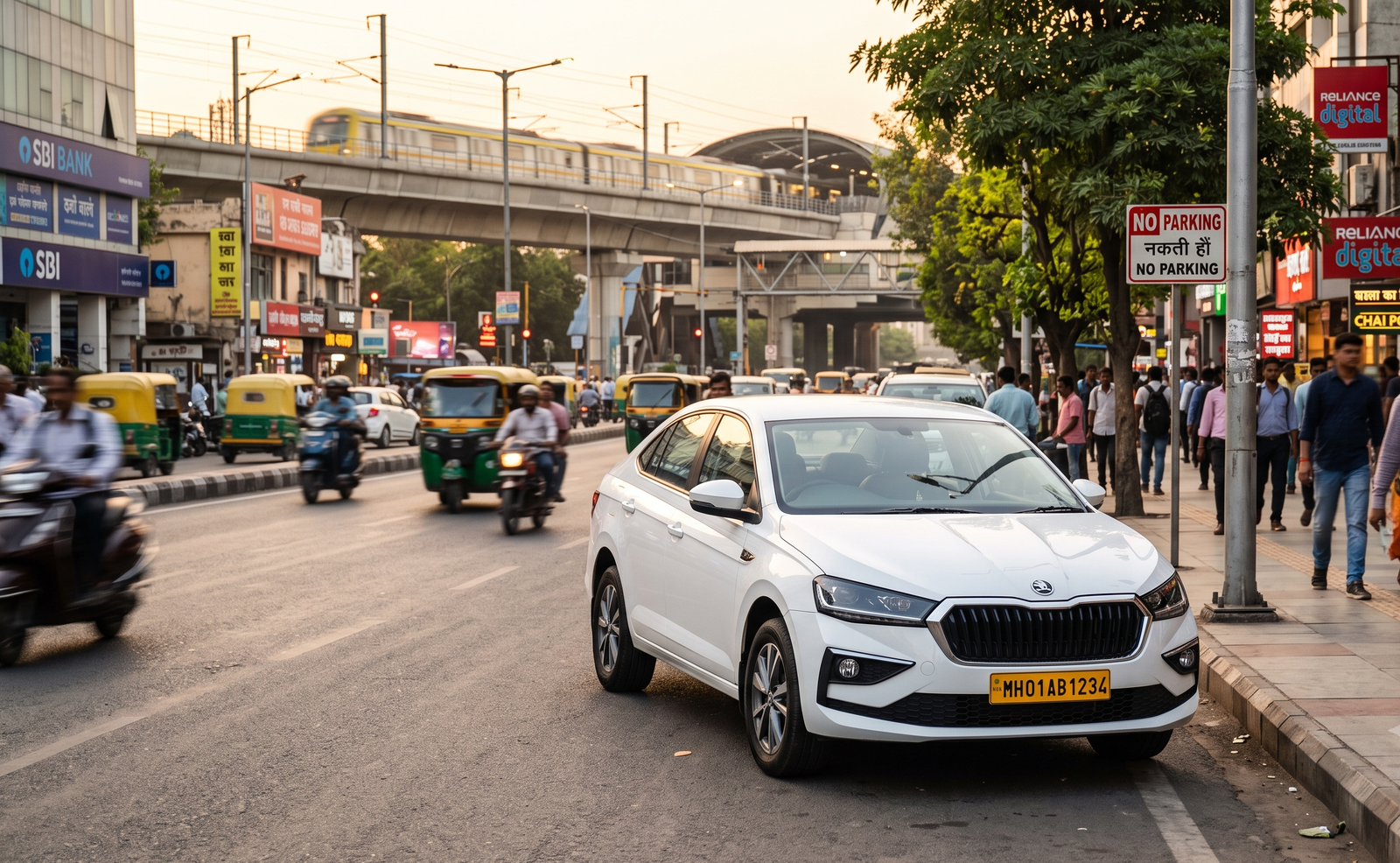
Capital & Financing Setup
- On-Road Commercial Price: ₹7,80,000
(Includes commercial registration, speed governors, GPS tracking units, and state fitness certification).
– Down Payment (approx. 20%): ₹1,50,000
– Commercial Vehicle Loan Amount: ₹6,30,000
– Commercial Loan Interest Rate: 11.5% (Compare current lending criteria on the SBI Commercial Vehicle Loan page—commercial loans carry higher rates and stricter eligibility than standard retail car loans)
– Loan Tenure: 5 Years (60 Months)
– Monthly Loan EMI: ₹13,850 / month
The Monthly Operating Ledger (Passive Rental Track)
Assume you lease the car to a driver on the standard market arrangement: the driver pays for fuel and covers daily operational tolls, while giving you a fixed payout of ₹900/day
Assuming the driver operates 26 days a month (with 4 days off for rest, servicing, or family commitments):
Table 1: Commercial Sedan Economics
| Expense / Income Item | Monthly Amount (INR) |
| Gross Monthly Payout (26 days × ₹900) | +₹23,400 |
| Commercial Loan EMI (5 Years) | -₹13,850 |
| Commercial Insurance & Permit Reserves | -₹3,500 |
| Maintenance, Oil & Tire Fund | -₹3,000 |
| Estimated Net Monthly In-Hand | +₹3,050 |
The Reality Check
You invested ₹1,50,000 in cash, signed a personal guarantee on a ₹6,30,000 loan, and your net monthly upside is approximately ₹3,000 to ₹3,500.
If the driver falls sick for 4 days, gets into a minor fender bender, or the car sits in a workshop waiting for replacement parts, your entire monthly margin disappears—and you must fund the ₹13,850 EMI directly out of your own pocket.
What if you drive it yourself full-time?
Gross platform earnings can reach ₹65,000 to ₹75,000/month. After deducting fuel (CNG/diesel at ~₹24,000), maintenance, taxes, and your EMI, you will pocket ₹22,000 to ₹28,000 net. That is a respectable living wage, but it is labor income, not passive cash flow.
3. Case Study 2: The Two-Wheeler / Bike Taxi (City Model)
If four-wheelers carry high capital risk, what about a budget commuter motorcycle (110cc–125cc) used for bike taxi or hyperlocal delivery apps?

Capital & Financing Setup
- On-Road Commuter Bike Cost: ~₹92,000
- Down Payment (approx. 20%): ₹18,000
- Two-Wheeler Loan Amount: ₹74,000
- Interest Rate: 13% (Tenure: 3 Years / 36 Months)
- Monthly Loan EMI: ~₹2,490 / month
Operational Economics (Active Rider Track)
Unlike cars, you cannot easily or legally rent out a privately registered motorcycle to a third party for passenger rides without a dedicated self-drive or commercial bike permit (which varies sharply by state). Therefore, this is almost always an active hustle.
Table 2: Bike Taxi / Delivery Economics
| Expense / Income Item | Monthly Average (INR) |
| Gross Earnings (8–9 hrs/day, 26 days) | +₹28,000 |
| Fuel Expense (~75 km/day) | -₹5,200 |
| Platform Fees / Deductions | -₹1,200 |
| Monthly EMI (3 Years) | -₹2,490 |
| Maintenance (Oil, Chain, Brake pads) | -₹800 |
| Net Take-Home Cash Flow | +₹18,310 |
The Reality Check
For an upfront capital commitment of under ₹20,000, the bike model offers a much safer debt-to-income ratio than an entry-level car. The monthly EMI (under ₹2,500) is easy to clear even with part-time evening and weekend shifts, making it a viable recovery cushion for students or early-career jobseekers.
4. The Hidden Drainers Most Beginners Overlook
If you decide to leverage vehicle financing, you must account for three line items that rarely appear in promotional dealership brochures:
1. Accelerated Depreciation
A private family car covers roughly 10,000 to 12,000 km per year. A commercial cab on aggregator platforms easily clocks 50,000 to 60,000 km per year.
By the end of your 5-year loan, your vehicle will have over 2,50,000 km on the odometer. Its resale value will be a fraction of a typical pre-owned car. You are trading asset depreciation for immediate liquidity.
2. The Commercial Permit & Insurance Multiplier
Private car insurance might cost ₹15,000 to ₹22,000 annually. Before applying, check the mandatory fitness testing and permit fees published on the official Parivahan Sewa Portal. A full commercial taxi policy—covering third-party passenger liability, driver legal liability, and zero-depreciation coverage—regularly lands between ₹38,000 and ₹48,000 per year, payable upfront on renewal.
3. Idle Time Is Fatal to Leverage
Debt works for you only when the underlying asset is running. When an asset stands still, the debt turns against you. If a hired driver quits unexpectedly, finding and vetting a trustworthy replacement with a verified commercial badge often takes 7 to 14 days. During that downtime, the EMI clock never stops ticking.
5. How to Safely Leverage Vehicle Financing (If You Decide to Do It)
If you still want to enter this space, here is the responsible, stress-tested blueprint to protect yourself:
Step 1: Secure an “EMI Sinking Fund” First
Never use your last ₹1.5 Lakh to make the down payment. Before taking delivery, set aside at least 3 to 4 months of EMIs in a liquid savings account. If your vehicle sits idle or suffers mechanical issues, your personal credit score won’t take a hit while repairs are underway.
Step 2: Consider a Certified Pre-Owned Commercial Vehicle
A 2-to-3-year-old vehicle has already absorbed the steepest part of its depreciation curve. While finding financing takes more legwork, your total loan exposure drops significantly, lowering your monthly break-even threshold.
Step 3: Run the Vehicle Yourself for the First 60 Days
If you plan to rent out a car to another driver, spend the first two months driving it yourself. You will learn the best-performing zones, peak-hour incentives, true maintenance patterns, and exact fuel efficiency. When you eventually hire a driver, you’ll know immediately whether their reported daily collections and mileage figures reflect reality.
The Bottom Line
Vehicle financing can be a practical bridge to self-employment, but treating a single financed vehicle as passive wealth creation is a misconception.
If you rely on an external driver for a single car, the profit margins are small, and the downside risk is substantial. True fleet profitability only begins when you own 4 to 5 vehicles outright—giving you enough scale to absorb downtime, maintenance cycles, and driver turnover.
If your startup capital is limited, focus on models with low financial overhead- such as launching an online store in India– to let the business prove its cash flow before scaling your liabilities.
Have you considered starting a fleet or driving on platform apps? What’s your biggest hesitation with vehicle financing? Let’s discuss in the comments below!