
Rural vs City Office Space: Where Should You Set Up Your First Office?
When deciding between rural vs city office space, most founders hear the same advice: move to a metro, get closer to investors, rent a desk in a crowded co-working hub, and chase the ecosystem.
But what if that advice is wrong—or at least incomplete?
This post breaks down the rural vs. city office space dilemma using a real, inspiring example: Interval, India’s first Global-Mentor Powered Practical Driven Skill School. Interval started in Areekode, a small town in Malappuram, Kerala. Only later did they expand to Kozhikode, a major city.
Their journey offers powerful lessons for anyone deciding where to plant their first flag.
The Interval Story: Small Town First, Big City Later
Starting in Areekode
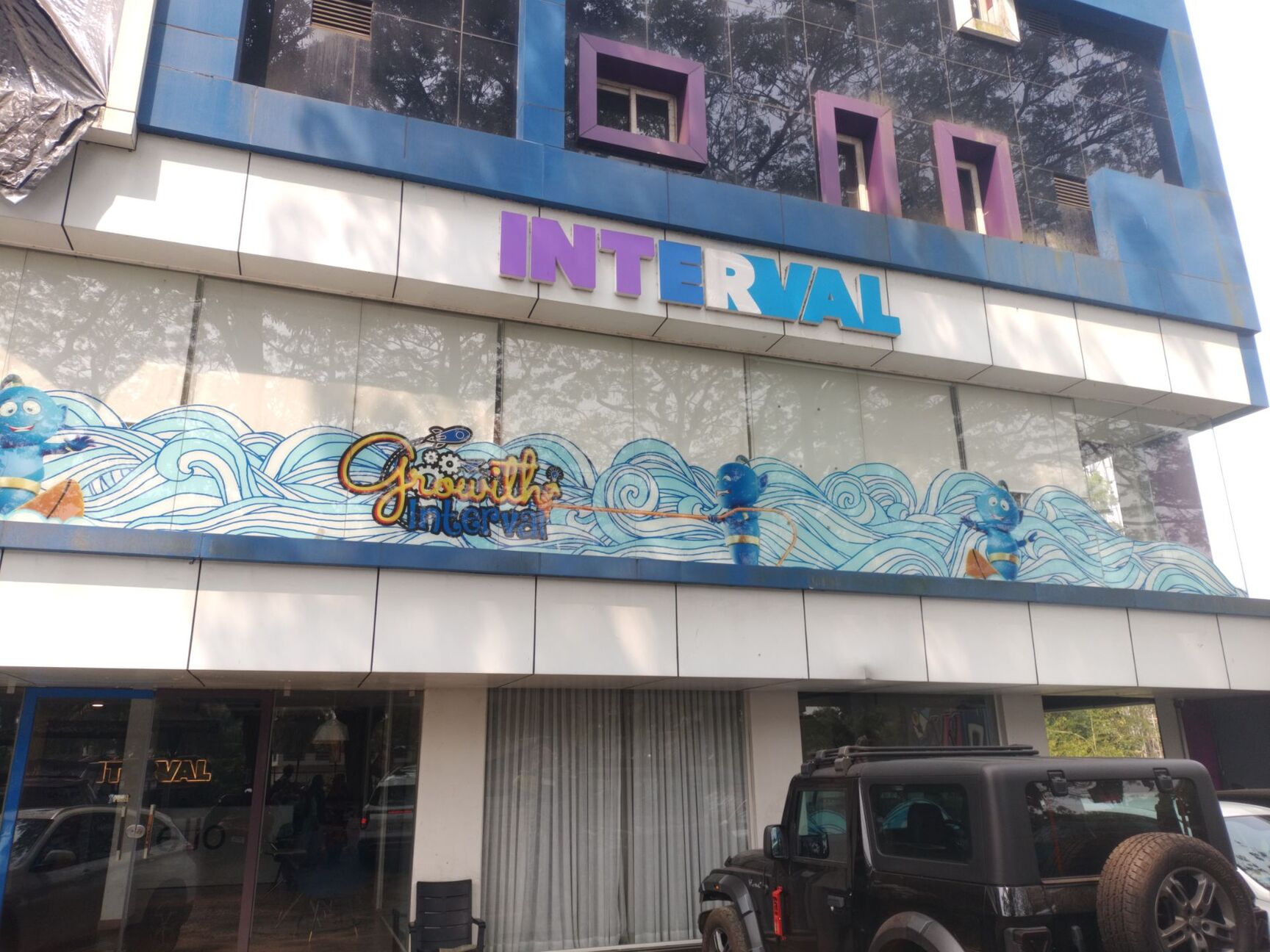
Interval was founded in 2021 by a group of friends from Areekode. Instead of rushing to a metro, they set up operations right in their hometown.
They began in a small rented apartment. Over time, they built a six-story, 30,000 sq ft headquarters—still in Areekode.
The results speak for themselves:
25,000+ students served across 30 countries
₹15 crore revenue within two years
300+ team members built locally
Average cost per seat under ₹800
That last number is stunning. In a metro, the same seat could cost ₹8,000 to ₹15,000 per month.
Expanding to Kozhikode

As Interval grew, they opened a presence at HiLITE Business Park in Kozhikode. This gave them access to a larger talent pool, better infrastructure, and stronger client connections.
They didn’t abandon Areekode. Their skill school, Interval SkillX, launched with its headquarters still anchored in their hometown.
This is the hybrid model in action: keep your roots rural, expand strategically urban.
Funding Without a Metro Address
Many founders believe investors only fund startups in Bangalore, Mumbai, or Delhi. Interval proves otherwise:
Backed by Kerala Startup Mission (KSUM)
Selected for Finland’s Talent Boost project—the only Indian startup invited
Secured angel funding and government grants while based in a small town
Location did not block access to capital. Execution did the talking.
Rural vs City Office Space: Advantages and Disadvantages
Advantages of a Rural Office
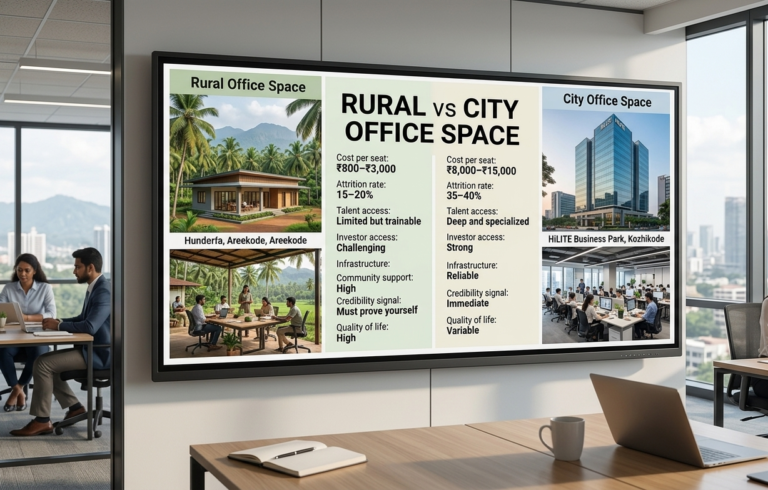
Dramatically lower costs: Rents in rural areas are 60–80% cheaper than metros. Interval’s cost per seat stayed under ₹800, creating a longer runway and lower financial strain.
Better talent retention: Attrition in Tier 2 and Tier 3 towns hovers around 15–20%, compared to 35–40% in metros.
Untapped local talent: A rural base taps into skilled individuals who prefer not to relocate.
Strong community support: Informal networks build high trust and dependable local goodwill.
Better quality of life: Shorter commutes and lower living costs lead to a happier team.
Disadvantages of a Rural Office
Limited specialized talent: Senior niche roles (advanced architecture, specialized design) are harder to source locally.
Investor distance: Venture capital networks remain concentrated in metro hubs.
Infrastructure variability: Power continuity, high-speed redundancy, and logistics can require dedicated setup.
Perception barriers: Enterprise clients occasionally question whether a small-town team can scale globally.
Advantages of a City Office
Ecosystem density: Accelerators, mentors, investors, and events operate in close proximity.
Deep talent pools: Specialized technical and executive roles can be hired on demand.
Instant credibility signal: A prime tier-1 commercial address can grease enterprise sales.
Plug-and-play infrastructure: Dedicated Grade-A commercial facilities eliminate operational headaches.
Disadvantages of a City Office
High burn rate: Commercial lease rates and metro salaries drain working capital fast.
High attrition: Churn rates of 35–40% create constant recruitment overhead.
Market noise: Standing out in a saturated startup ecosystem requires heavy marketing spend.
Employee financial stress: High personal living expenses place extra compensation pressure on early teams.
The Government Factor: Kerala’s Support Ecosystem
Kerala provides structured startup assistance statewide:
KSUM Grants: Idea Grants, Productisation Grants, and scale-up non-dilutive funding.
Global Exposure: Delegations and international exchange backing.
Work Near Home (WNH): Developing distributed, modern co-working infrastructure across regional towns.
Funding follows potential, not postal codes.
A Framework for Choosing Your Location
Check Location Sensitivity: Digital, tutoring, or SaaS products can run anywhere. Heavy hardware or high-touch local B2B enterprise requires hub access.
Map 12-Month Runway: If capital efficiency and low churn determine survival, lean rural. If daily investor networking drives your model, lean urban.
Adopt a Staged Hybrid Model: Start lean in a rural setting to achieve product-market fit; open an urban satellite when scaling demands it.
Compensate with Culture: Interval balanced their rural location by providing quality accommodation, meals, and strong community perks.
Rural vs City Office Space: Quick Comparison
| Factor | Rural Office Space | City Office Space |
| Cost per seat | ₹800 – ₹3,000 | ₹8,000 – ₹15,000 |
| Attrition rate | 15% – 20% | 35% – 40% |
| Talent access | Trainable, high loyalty | Deep, highly specialized |
| Investor access | Remote-first / strategic visits | High serendipity & proximity |
| Infrastructure | Requires diligence / WNH hubs | Turnkey, highly reliable |
| Community support | High local integration | Low / purely transactional |
| Credibility signal | Proven via results | Immediate via address |
| Quality of life | High, low commute | Variable, high stress |
Conclusion: It’s About Sequence, Not Location
The rural vs city office space choice is not binary. The real question is sequence:
Prove your model where you are leanest: Areekode gave Interval low burn and room to test.
Expand where it serves a tactical purpose: Kozhikode provided executive reach when the business matured.
Retain your core advantages: Never discard low-burn foundations simply for vanity.
If your product can be delivered digitally, you do not need a metro pin code to build a world-class Business.