
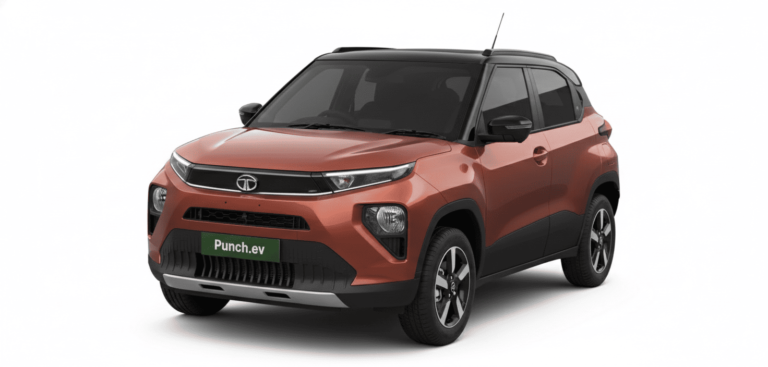
The Indian automotive sector is currently navigating a period of unprecedented disruption, characterized by a rapid pivot toward electrification and a heightening of safety standards. At the forefront of this movement is Tata Motors, which has strategically utilized its dominant market share—reaching 43.35 percent of the electric passenger vehicle segment in January 2026—to redefine urban mobility. The newly released 2026 Tata Punch EV Facelift represents a critical evolution in the micro-SUV category, being the primary vehicle built upon the advanced acti. ev (Advanced Connected Tech-Intelligent Electric Vehicle) architecture. Officially unveiled for launch on February 20, 2026, this model seeks to address the multifaceted demands of the modern Indian consumer: safety, status, sustainability, and technological sophistication.
The Structural Foundation: The acti.ev Architecture
The 2026 Tata Punch EV is not merely a conversion of an existing internal combustion engine (ICE) platform but is built on a dedicated Gen 2 pure-electric architecture. This engineering choice has profound implications for the vehicle’s dynamics and packaging. By utilizing a dedicated EV platform, engineers have managed to integrate the battery pack as a structural component of the chassis, resulting in a significantly lower center of gravity compared to the petrol-powered Punch. This translates into improved handling characteristics and reduced body roll during high-speed maneuvers.
The acti.ev platform allows for a flat floor, which maximizes cabin volume and provides a sense of spaciousness often absent in micro-SUVs. Furthermore, the modular nature of the architecture supports future-ready technologies, including cloud-connected diagnostics and advanced thermal management systems that are essential for maintaining battery health in the extreme climatic conditions prevalent in regions like Kerala and Northern India. The transition to Gen 2 architecture also facilitates the inclusion of a “frunk” (front trunk) in some configurations, although the Punch EV prioritizes an optimized front-end for pedestrian safety and crumple zones.
 Aesthetic Evolution and Exterior Design Philosophy
 Aesthetic Evolution and Exterior Design Philosophy
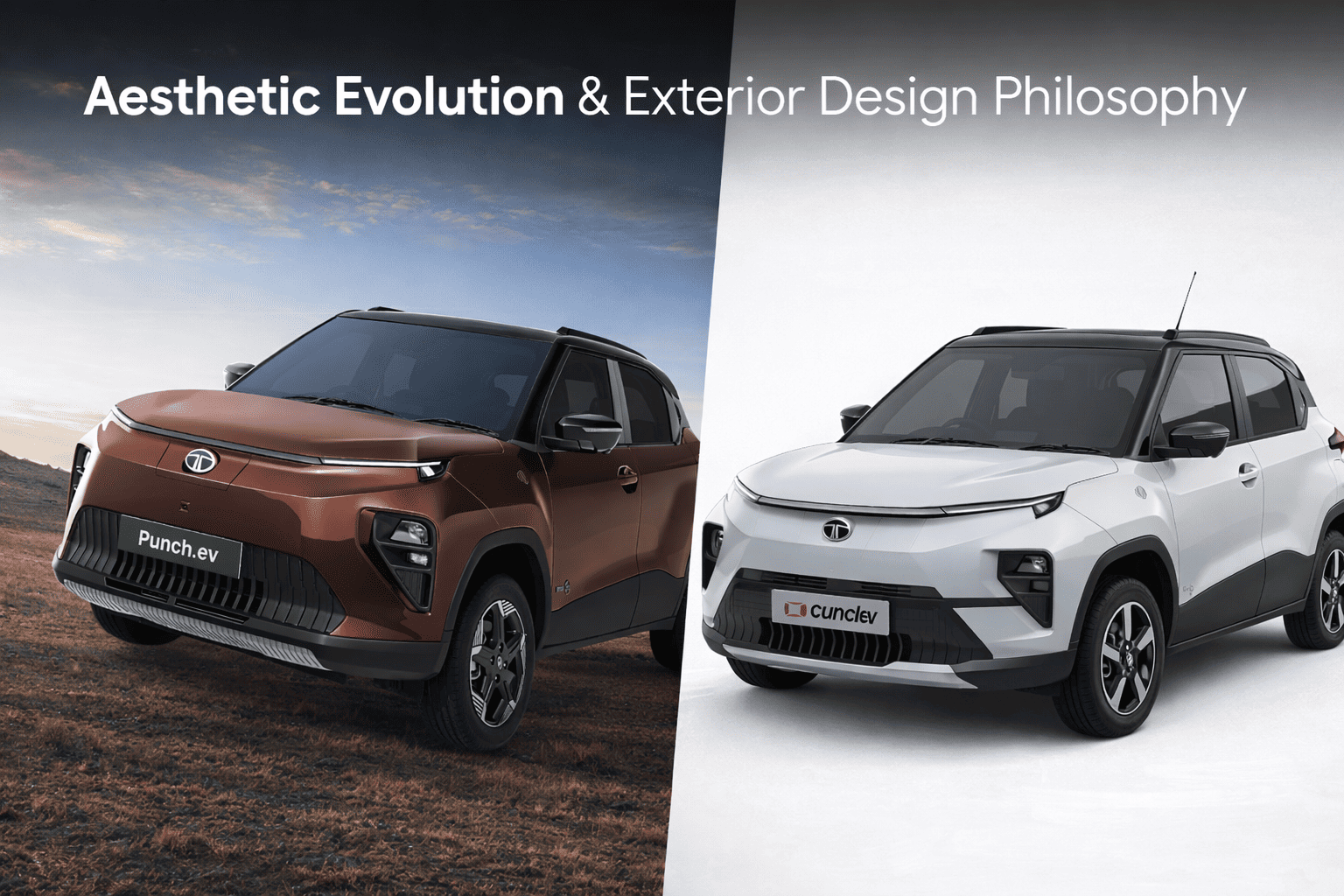
The 2026 facelift introduces several subtle yet impactful changes to the exterior, moving the Punch EV closer to the design language of Tata’s larger premium SUVs like the Nexon EV and Harrier EV. The visual updates are concentrated at the front fascia, emphasizing the vehicle’s electric identity through a cleaner and more structured appearance.
The Front Fascia and Lighting Signature
In the updated 2026 model, the black plastic strip that previously connected the headlamps has been removed in favor of a sealed-off grille area. This modification enhances the aerodynamic profile of the car while providing a more contemporary and minimal look. The daytime running lamps (DRLs) have been redesigned to include a full-width LED light bar that spans the bonnet line, creating a distinctive lighting signature that is visible from a distance.
The main headlamp units are now separate and sit lower on the bumper, integrated into revised housings that feature sharper creases and more pronounced contours. The lower section of the front bumper includes a revised air dam and a redesigned skid plate, further emphasizing the vehicle’s rugged, urban-focused SUV stance. These changes collectively differentiate the 2026 EV facelift from both its predecessor and the standard petrol-powered Punch models currently on the road.
Color Palette and Aero Enhancements
Tata Motors has introduced new exterior color options to coincide with the 2026 launch. Most notable is the Sunlit Yellow with a contrasting black roof, a combination borrowed from the Harrier, which highlights the vehicle’s revised styling details. Additionally, a Supernova Copper hue and Pure Grey have been added to the catalog.
The profile of the vehicle remains synonymous with the nameplate’s “boxy” and upright proportions, ensuring high ground clearance of 190 mm—a vital metric for navigating the pothole-ridden or flooded roads often found in monsoon-hit states like Kerala. To further efficiency, the 2026 model receives newly designed aero-focused alloy wheels, likely sized at 195/60 R16, which minimize air turbulence around the wheel arches.
| Exterior Dimension | Measurement |
| Overall Length | 3857 mm |
| Overall Width | 1742 mm |
| Overall Height | 1633 mm |
| Wheelbase | 2445 mm |
| Ground Clearance (Unladen) | 190 mm |
Data derived from.
Interior Refinement and Technological Integration
The cabin of the 2026 Tata Punch EV Facelift serves as the primary interface for its advanced technological suite. While the overall layout remains evolutionary, the introduction of premium materials and high-resolution displays brings a “segment-above” feel to the micro-SUV.
The Digital Cockpit and Infotainment
The most significant interior update is the inclusion of a larger 12.3-inch touchscreen infotainment system in the higher-spec Empowered variants. This screen runs an updated version of Tata’s software UI, which is designed to be more intuitive and responsive. It supports wireless Apple CarPlay and Android Auto, along with the Arcade.ev suite, which allows for in-car video streaming and gaming during charging sessions.
Accompanying the infotainment screen is a 10.25-inch fully digital instrument cluster. This display provides critical information to the driver, including real-time energy flow, battery state of charge (SOC), and navigation maps directly in the line of sight. The steering wheel has been upgraded to a twin-spoke design featuring an illuminated central logo, further aligning the Punch EV with the premium aesthetics of the Nexon and Curvv lineups.
Comfort and Convenience Amenities
To maintain its competitive edge in the sub-15 lakh segment, Tata has equipped the 2026 Punch EV with features previously reserved for luxury vehicles:
Ventilated Front Seats: A critical addition for the humid Kerala climate, significantly enhancing long-distance comfort.
Wireless Charging: A dedicated pad for inductive smartphone charging, reducing cable clutter in the cockpit.
Auto-Dimming IRVM: Enhances night driving safety by automatically reducing glare from trailing vehicles.
Voice-Enabled Sunroof: A single-pane electric sunroof that can be controlled via voice commands, a highly popular feature among Indian car buyers.
Air Purifier: Integrated system with AQI display, ensuring a healthier cabin environment in polluted urban centers.
Performance, Battery, and Charging Dynamics
 Performance, Battery, and Charging Dynamics
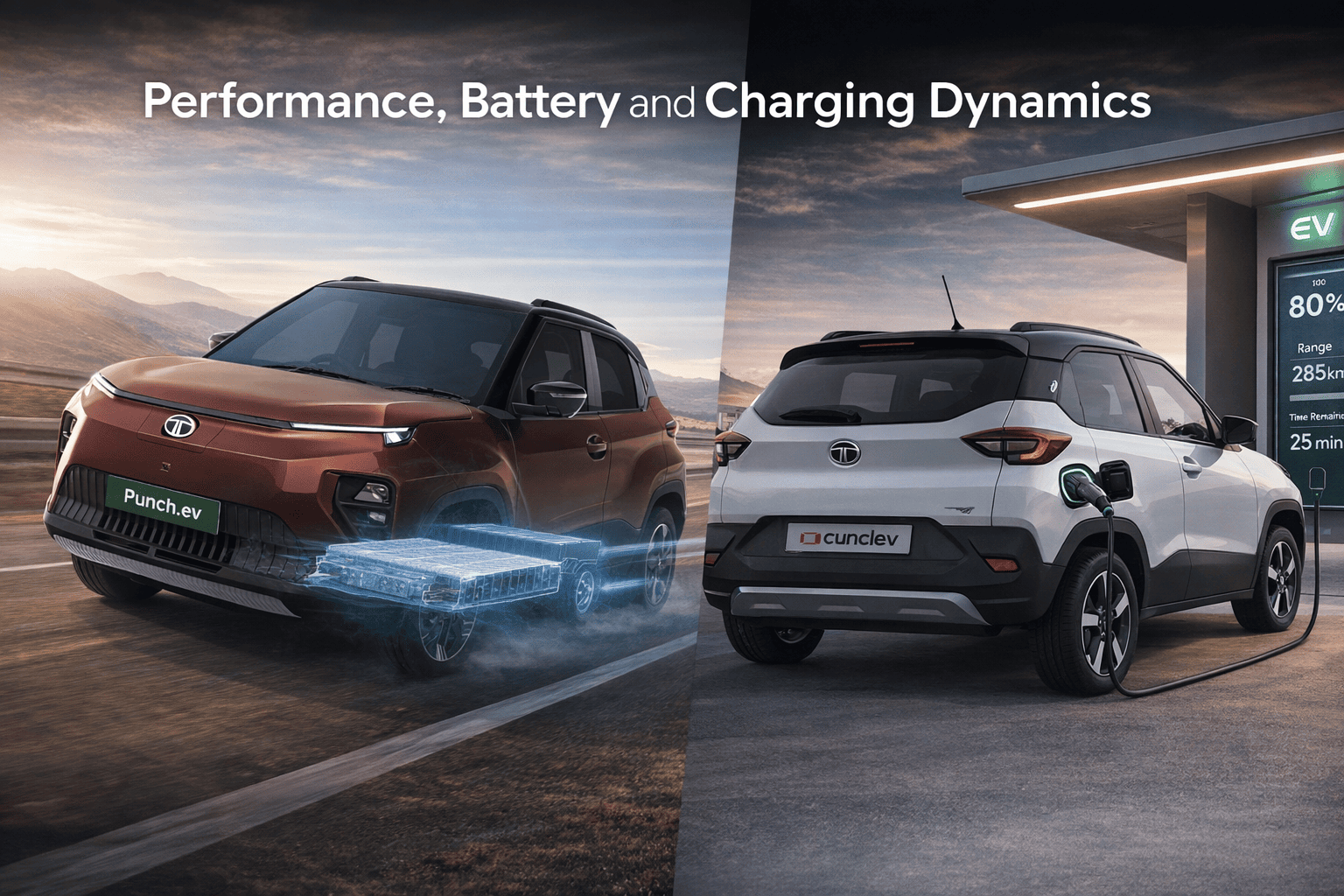
The 2026 Tata Punch EV Facelift continues the strategy of offering two distinct battery and performance tiers: the Standard (Medium Range) and the Long Range (LR) versions. This allows Tata to cater to both budget-conscious city dwellers and those who require a primary vehicle capable of inter-city travel.
Battery and Motor Specifications
The Standard variant utilizes a 25 kWh Lithium-ion battery pack, while the Long Range variant is powered by a 35 kWh unit. Both variants use a Permanent Magnet Synchronous Motor (PMSM) driving the front wheels, but with different power outputs to match their respective battery capacities.
| Metric | Standard (Medium Range) | Long Range (LR) |
| Battery Capacity | 25 kWh | 35 kWh |
| Peak Power Output | 82 hp (60 kW) | 122 hp (90 kW) |
| Peak Torque Output | 114 Nm | 190 Nm |
| 0-100 km/h (Claimed) | 13.5 Seconds | 9.5 Seconds |
| Top Speed | 120 km/h | 140 km/h |
| Claimed MIDC Range | 315 km | 421 km |
Data synthesized from.
Charging Efficiency and Time Analysis
A significant upgrade for the 2026 Long Range model is the improved charging rate. The LR variants can now support a 1.2 C charging rate, which allows the 35 kWh battery to go from 10 percent to 80 percent in just 40 minutes when using a 50 kW DC fast charger. This is a substantial improvement for users who frequently use highway charging networks. The Standard variant takes approximately 56 minutes for a similar charge level on a 50 kW DC charger.
For residential or commercial AC charging, Tata offers two options. The 3.3 kW AC wall box charger is the standard inclusion, while a faster 7.2 kW AC charger is available for an additional cost (approximately ₹50,000) or included in higher trims.
| Charger Specification | 25 kWh Battery (10-100%) | 35 kWh Battery (10-100%) |
| 15A Portable Charger | ~9.4 Hours | ~13.5 Hours |
| 3.3 kW AC Wall Box | ~9.4 Hours | ~13.5 Hours |
| 7.2 kW AC Fast Charger | ~3.6 Hours | ~5.0 Hours |
| 50 kW DC Fast Charger | ~56 Minutes (10-80%) | ~40 Minutes (10-80%) |
Data derived from.
Real-World Range Realities and the “800 km” Rumor
One of the most frequent queries regarding the Tata Punch EV—as seen in search trends and “People also ask” queries—concerns the possibility of an 800 km range. Systematic research into global automotive trends for 2026 suggests that while 800 km ranges are being targeted by high-end manufacturers like Toyota and BMW for their flagship luxury models, no micro-SUV in the Indian market, including the Tata Punch EV, currently offers such a range.
Claimed vs. Actual Range
The Tata Punch EV Long Range has a claimed MIDC (Modified Indian Driving Cycle) range of 421 km. However, real-world testing consistently indicates that these figures are optimistic and highly dependent on driving style, terrain, and climate control usage.
In rigorous independent testing, the Long Range variant typically achieves a real-world range between 240 km and 270 km. In one specific “Drive to Death” test, the vehicle delivered 258.6 km of range starting from a 100 percent charge down to 1 percent, under mixed conditions with the AC running. For the Standard 25 kWh variant, the real-world range is expected to settle between 180 km and 210 km, making it primarily suitable for urban commuting rather than long-distance travel.
Factors Influencing EV Efficiency
Several variables impact the efficiency (measured in km/kWh) of the Punch EV:
Regenerative Braking: The vehicle features 4 levels of regen. While Level 3 (strongest) captures more energy, it can lead to jerky driving in traffic, requiring more throttle input. Level 2 is often found to be the most efficient balance for urban environments.
Ambient Temperature: In high temperatures (e.g., 40°C), the climate control system works overtime, which can reduce the range by 10-15 percent.
Driving Mode: The “Eco” mode restricts performance and optimizes power delivery, whereas “Sport” mode provides maximum torque at the cost of significantly higher battery drain.
Safety Standards and Bharat NCAP Performance
Safety is a non-negotiable priority for Tata Motors, and the Punch EV stands as a benchmark for its segment. The 2026 facelift has retained the perfect 5-star safety rating from Bharat NCAP (BNCAP), reinforcing its reputation as one of the safest vehicles in India.
BNCAP Crash Test Report Breakdown
The Punch EV’s structural integrity, derived from the high-tensile steel used in the acti.ev platform, provides exceptional protection during collisions. The 2026 model underwent comprehensive testing for both adult and child occupant protection.
| BNCAP Test Category | Score | Rating |
| Adult Occupant Protection (AOP) | 30.58 / 32.00 | 5 Stars |
| Child Occupant Protection (COP) | 45.00 / 49.00 | 5 Stars |
| Frontal Offset Deformable Barrier | 14.71 / 16.00 | Good |
| Side Moveable Deformable Barrier | 15.87 / 16.00 | Good |
Data derived from.
In the frontal impact test, the vehicle demonstrated good protection for the head, neck, and thighs of both the driver and the front passenger. Child safety was equally highlighted, with full marks in dynamic testing for both 18-month-old and 3-year-old dummies placed in rear-facing ISOFIX seats.
Active and Passive Safety Suite
The 2026 Punch EV is equipped with a robust safety package as standard:
Six Airbags: Comprehensive protection including front, side, and curtain airbags.
Electronic Stability Control (ESC): Standard across all trims to prevent skidding during evasive maneuvers.
All-Wheel Disc Brakes: Included in the Long Range variants for superior thermal management and stopping distances.
360-Degree Camera System: Provides a bird’s-eye view of the vehicle, which is invaluable for maneuvering in tight urban spots.
Level 2 ADAS (Speculated): Reports suggest that higher trims may feature Advanced Driver Assistance Systems, including autonomous emergency braking and blind-spot detection, although Tata typically confirms these features on a variant-by-variant basis at launch.
Market Dynamics and Kochi On-Road Pricing
For potential buyers in Kerala, specifically in the Kochi and Malappuram regions, the on-road price is the ultimate deciding factor. The 2026 Tata Punch EV Facelift is expected to be priced from ₹9.99 Lakh (ex-showroom) for the base Smart variant, extending up to ₹14.44 Lakh for the top-end Empowered Plus S LR with a fast charger.
Detailed Price Breakdown in Kochi
On-road prices in Kochi include the ex-showroom price plus Individual Registration (RTO), Insurance, and other miscellaneous charges like FastTag and Road Safety Cess. It is important to note that Kerala has historically provided significant incentives for EVs, although the road tax landscape is evolving across India in 2026.
| Variant | Ex-Showroom | Est. On-Road Kochi |
| Smart 3.3 (Base) | ₹ 9,99,000 | ₹ 11,04,560 |
| Smart Plus 3.3 | ₹ 11,14,000 | ₹ 12,38,000 |
| Adventure 3.3 | ₹ 11,84,000 | ₹ 13,14,000 |
| Adventure S 3.3 | ₹ 12,14,000 | ₹ 13,46,000 |
| Empowered 3.3 | ₹ 12,64,000 | ₹ 14,00,000 |
| Adventure LR 3.3 | ₹ 12,84,000 | ₹ 14,22,000 |
| Empowered Plus S LR 3.3 | ₹ 13,94,000 | ₹ 15,40,000 |
| Empowered+ S LR AC FC | ₹ 14,44,000 | ₹ 16,03,000 |
Data synthesized from.
Running Cost and Economic Feasibility
The “Cost per 1 km” is a metric that heavily favors the Punch EV. At an electricity rate of ₹8.00 per unit, the Punch EV can be charged fully (Standard 25 kWh) for approximately ₹200. This yields a running cost of roughly ₹0.70 to ₹1.00 per km, assuming a real-world range of 200 km. In contrast, a petrol-powered Punch with a real-world city mileage of 13 kmpl has a running cost of approximately ₹8.00 per km (at ₹105 per liter of petrol).
Over a three-year analysis period, a user driving 80 km per day (29,200 km per year) would spend approximately ₹61,320 on electricity for the Punch EV, compared to over ₹6.13 Lakh on fuel for the petrol version. Even with the higher initial purchase price, the “Total Cost of Ownership” (TCO) for the EV becomes favorable within 4 to 6 years of usage.
Comparative Analysis with Competitors
 Comparative Analysis with Competitors
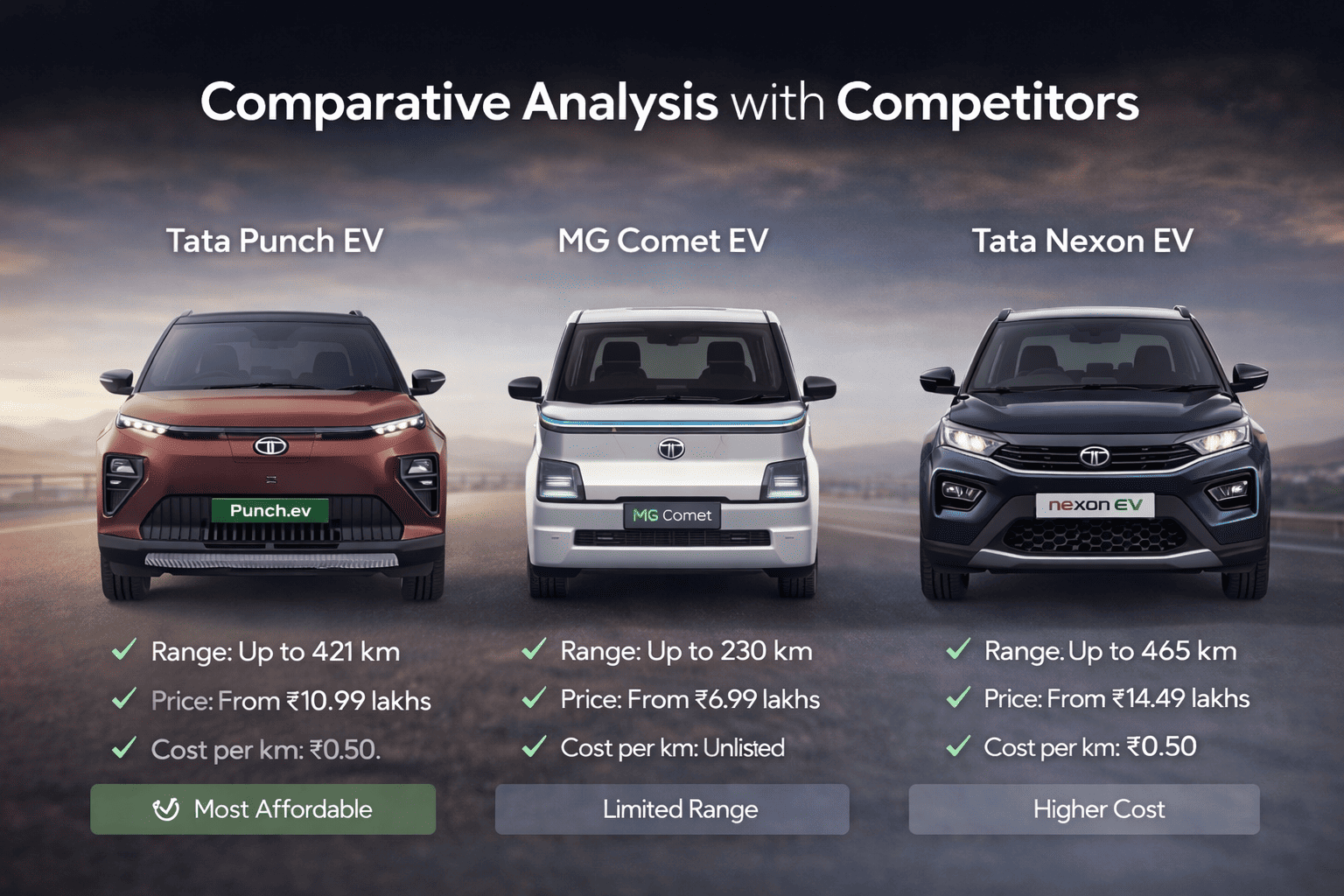
The Tata Punch EV faces competition from both hatchback-style EVs and compact electric SUVs.
Punch EV vs. Citroen eC3
The Citroen eC3 is the most direct competitor in the sub-₹15 lakh bracket. While the eC3 offers a more comfortable, “magic carpet” ride quality and a slightly longer wheelbase, it falls short on technological features and safety equipment. The eC3 uses an air-cooled 29.2 kWh battery, which is generally considered less efficient at handling high-speed charging heat than the liquid-cooled system in the Punch EV.
Punch EV vs. MG Windsor EV
The MG Windsor EV is a larger crossover that offers significantly more interior space and a premium glass roof. However, the Windsor EV is also priced higher, with top-end variants reaching ₹18.50 Lakh. The Punch EV remains the more viable choice for those who prioritize a compact footprint for city navigation and a higher ground clearance for rough roads.
| Feature | Tata Punch EV (LR) | Citroen eC3 | MG Windsor EV |
| Battery Size | 35 kWh | 29.2 kWh | 38 kWh |
| Motor Power | 122 hp | 57 hp | 134 hp |
| Torque | 190 Nm | 143 Nm | 200 Nm |
| Real-World Range | ~260 km | ~210 km | ~280 km |
| Safety Rating | 5 Star (BNCAP) | 0 Star (GNCAP) | 5 Star (BNCAP) |
Data compiled from.
Local Availability: Malappuram and Kozhikode Showrooms
For readers of nuhmanareekode.com, local availability and after-sales support are paramount. Tata Motors has established a robust dealership network in Northern Kerala to support the new Punch EV launch.
Luxon Tata, Areekode: Ground Floor, Mukkam Road, Thekkinchuvadu. Near Bharath Car Wash. Contact: +91 8879076009.
KVR Automotive, Manjeri: Kozhikode Malappuram Bypass, Thurakkal Bypass, Manjeri. Contact: 7510333444.
Luxon Motors, Munduparamba: Near Fire Station, Bypass Junction. Malappuram – 676509.
KVR Automotive, Kondotty: Kuruppath, Ground Floor, Malappuram – 673638.
These showrooms provide a dedicated EV sales and service experience, with charging facilities often available for customers.
The Future Outlook: Challenges and Opportunities
The trajectory for the Tata Punch EV in 2026 is one of growth, but it is not without hurdles. The Union Budget 2026-27 has shifted focus towards supply-side maturity, focusing on the “Rare Earth Corridor” in states like Kerala to manufacture indigenous EV motors and magnets, which could eventually lead to further price reductions.
However, “range anxiety” remains a psychological barrier. While the government has released over ₹2,000 crore for public charging infrastructure through schemes like PM E-DRIVE, the density of chargers in rural Kerala still lags behind urban centers like Ernakulam or Thiruvananthapuram. Furthermore, as EV penetration increases, states like Karnataka have already begun reintroducing road taxes, a trend that may eventually reach Kerala, thereby affecting the initial affordability of these vehicles.
Conclusions
The 2026 Tata Punch EV Facelift is a pivotal product that successfully bridges the gap between affordable urban mobility and premium electric vehicle features. Its foundation on the acti.ev architecture provides it with a structural and safety advantage that is currently unmatched in the sub-₹15 lakh segment. With a 5-star Bharat NCAP rating and a real-world range that comfortably covers the daily needs of over 90 percent of Indian commuters, it is the definitive choice for those looking to transition from internal combustion to electric.
For the residents of Kochi, Malappuram, and the surrounding regions, the Punch EV offers a unique combination of high ground clearance, premium tech, and incredibly low running costs. While the “800 km range” remains a distant target for the industry at large, the 2026 Punch EV delivers exactly what is required for the Indian road: a robust, safe, and economically viable SUV that does not compromise on performance or style. As Tata Motors continues to expand its service network and the national charging infrastructure grows, the Punch EV is well-positioned to remain the market leader throughout 2026 and beyond.
Read More:…