As the crescent moon marks the beginning of the holy month, Muslims around the world embark on a journey of self-reflection, fasting, and intense devotion. While fasting is a physical pillar of this month, the spiritual core of Ramadan is inextricably linked to the Holy Quran. It was during this blessed month that the first verses were revealed to Prophet Muhammad (PBUH), transforming Ramadan into the “Month of the Quran.”
For many, finding the time to sit and read can be a challenge amidst busy schedules. This is where engaging with beautiful Quran audio becomes a transformative practice, allowing the divine words to resonate within the heart at any moment of the day.
The Sacred Connection: Ramadan and the Quran
The relationship between Ramadan and the Quran is fundamental. The Quran describes itself as a “guidance for mankind” that was sent down in this specific month. Engaging with quran recitation during these thirty days isn’t just a tradition; it is a way to recharge one’s faith.
When you listen to quran audio for free, you are participating in an act of worship that dates back centuries. The companions of the Prophet would often spend their nights listening to the rhythmic and melodic delivery of the verses, seeking a deeper understanding of their creator’s message.
Why Listening is as Important as Reading
In the Islamic tradition, “Al-Qur’an” literally means “The Recitation.” While reading the text is highly rewarded, listening to a beautiful Quran audio performance carries its own unique spiritual weight and characteristics:
Spiritual Tranquility (Sakinah): The Quran mentions that hearts find rest in the remembrance of Allah. A melodic quran recitation has a physiological effect, lowering stress and providing a sense of divine peace.
Focus and Contemplation (Tadabbur): Sometimes, hearing the words allows you to focus more on the meaning and the “soul” of the verses rather than just the pronunciation of letters.
Accessibility for All: Whether you are commuting, working, or resting, having access to quran audio for free ensures that the word of Allah is always within reach, regardless of your literacy level or location.
Correcting Tajweed: For students of the Quran, listening to expert reciters is the best way to master the rules of Tajweed (proper pronunciation) and rhythm.
Elevate Your Ramadan Experience
This year, make a conscious effort to complete the Quran, even if your schedule is packed. By integrating quran recitation into your daily routine, you turn your environment into a sanctuary. Whether you are looking for a specific surah or want to go through the entire book, high-quality audio makes the journey effortless and deeply moving.
Below, we have organized the entire Quran into its 30 Juz (sections). Each link will take you directly to the specific audio file, allowing you to follow along with the traditional Ramadan completion schedule.
Ready to Listen?
Select a Juz below to start your spiritual journey with our beautiful Quran audio collection.
Checking the weather tomorrow is something most of us do every single day — before we plan a morning run, decide what to wear, or figure out whether to carry an umbrella. Yet despite how often we check tomorrow’s weather forecast, very few people understand what’s actually behind those predictions, or how to read them with confidence.
In this guide, we’ll walk you through everything you need to know about checking and understanding the weather tomorrow — from the science behind short-range forecasts to the best tools available, practical preparation tips, and why accuracy matters more than ever in today’s world.
What Does a “Weather Tomorrow” Forecast Actually Tell You?
When you look up the weather for tomorrow, you’re accessing a short-range forecast — typically a 24-hour prediction generated using real-time atmospheric data, satellite imagery, and numerical weather prediction (NWP) models. These models process billions of data points gathered from weather stations, weather balloons, ocean buoys, and satellites orbiting the Earth.
Modern weather forecasting has become remarkably accurate. According to the National Oceanic and Atmospheric Administration (NOAA), today’s 24-hour weather forecasts are correct roughly 95% of the time for basic conditions like temperature ranges and precipitation likelihood. That means when you check the weather tomorrow, you can trust those predictions with a high degree of confidence — as long as you’re reading them correctly.
A standard tomorrow’s weather forecast includes:
High and low temperatures — the expected range for the day
Precipitation probability — the percentage chance of rain, snow, or other precipitation
Wind speed and direction — important for outdoor activities and travel
Humidity levels — affect how temperature actually feels (heat index or wind chill)
UV Index — how intense solar radiation will be at ground level
Sunrise and sunset times — useful for planning outdoor activities
Why Checking Tomorrow’s Weather Matters More Than You Think
Many people glance at the weather tomorrow and move on without giving it much thought. But understanding the forecast in depth can make a real difference in your daily life, safety, and even finances.
Personal Safety: Severe weather events — thunderstorms, ice, dense fog, high winds — can pose serious hazards if you’re caught unprepared. Checking the weather tomorrow the night before, gives you time to adjust plans, delay travel, or take shelter precautions.
Health and Well-being: Extreme heat or cold can affect vulnerable populations, including the elderly, children, and those with chronic conditions. Knowing whether tomorrow brings a heat advisory or a hard freeze lets caregivers and individuals take preventative action.
Outdoor Activities: Hikers, cyclists, gardeners, construction workers, and athletes all rely on accurate weather tomorrow to stay safe and productive. A forecast check takes 30 seconds and can save hours of disruption.
Economic Decisions: Farmers, event planners, contractors, and retail businesses make significant decisions based on upcoming weather. Even for individuals, knowing that tomorrow will bring heavy rain could affect whether you choose to drive or use public transit, potentially saving time and money.
How to Read a Weather Forecast Like a Pro
Understanding the weather tomorrow isn’t just about knowing if it will rain. Here’s how to interpret the most important forecast elements:
Precipitation Probability: A 40% chance of rain does NOT mean it will rain 40% of the time. It means there’s a 40% probability that measurable rainfall will occur somewhere in the forecast area. Many people misread this and either over-prepare or under-prepare as a result.
“Feels Like” Temperature: Raw temperature numbers don’t tell the whole story. In winter, wind chill can make 35°F feel like 20°F. In summer, high humidity can make 88°F feel like 100°F. Always check the “feels like” or “apparent temperature” when planning tomorrow’s activities.
Wind Gusts vs. Sustained Winds: Forecasts often list both average wind speed and peak gusts. If tomorrow’s weather shows 15 mph winds with gusts up to 35 mph, the gusts matter more for activities like cycling or driving a high-profile vehicle.
Hourly Breakdowns: Most modern weather apps let you view the weather tomorrow on an hour-by-hour basis. This is invaluable — a day that looks stormy overall might only have rain in the morning, clearing by noon for an afternoon outdoor event.
The Best Tools for Checking the Weather Tomorrow
There are dozens of apps and websites available for checking tomorrow’s weather forecast. Here are the most reliable, based on forecast accuracy and ease of use:
National Weather Service (weather.gov): For users in the United States, this is the gold standard. The NWS publishes detailed, expert-reviewed forecasts with official severe weather alerts. It’s free, ad-free, and uses the most advanced government weather models.
Weather.com (The Weather Channel): A popular option with a user-friendly interface, hourly breakdowns, and detailed weather tomorrow forecasts, including radar maps, precipitation timelines, and lifestyle indices like allergy and flu levels.
AccuWeather: Known for its “MinuteCast” feature, which provides minute-by-minute precipitation forecasts. If you’re wondering exactly when tomorrow’s rain will start and stop, AccuWeather is particularly useful.
Dark Sky / Apple Weather: Integrated into iOS devices, Apple Weather (which absorbed Dark Sky) provides hyperlocal forecasts and excellent precipitation timing. Great for mobile users who want tomorrow’s weather at a glance.
Google Weather: Simply typing “weather tomorrow” into Google gives an instant forecast powered by The Weather Channel data. Fast, convenient, and accurate for most everyday needs.
Preparing for Tomorrow’s Weather: Practical Tips
Once you’ve checked the weather tomorrow, preparation is the next step. Here’s how to act on what you find:
For Rain or Thunderstorms: Pack an umbrella or rain jacket. If severe thunderstorms are forecast, avoid outdoor activities, keep electronics unplugged during storms, and have a plan if lightning is expected during your commute or outdoor plans.
For Extreme Heat: Stay hydrated, avoid strenuous outdoor activity during peak afternoon hours (typically 12–4 PM), wear lightweight and light-colored clothing, and check on elderly neighbors or family members.
For Cold, Ice, or Snow: Allow extra travel time, ensure your vehicle is prepared (check tire pressure, washer fluid, and battery), dress in layers, and keep a cold-weather emergency kit in your car.
For High Winds: Secure outdoor furniture and decorations, avoid parking under trees or near scaffolding, and delay cycling or motorcycling if gusts are expected above 30 mph.
A Note on Forecast Reliability
Short-range weather forecasts have improved dramatically over the past few decades. The atmosphere is a chaotic system, and unexpected developments — particularly with convective storms — can surprise even the most sophisticated models. For this reason, meteorologists encourage people to check the weather tomorrow from multiple reputable sources and to pay close attention to official weather alerts issued by government meteorological agencies.
If a severe weather watch or warning is issued for tomorrow, always take it seriously, even if conditions outside currently appear calm.
Checking the weather is a small habit that pays enormous dividends in safety, comfort, and preparedness. Whether you rely on a government forecast portal, a smartphone app, or a quick Google search, the key is knowing how to read and interpret what you find — not just glance at a number and move on.
With reliable short-range forecasting tools now at everyone’s fingertips, there’s no reason to be caught off guard by tomorrow’s weather. Make it a nightly habit: check the forecast, prepare accordingly, and step into tomorrow with confidence.
Stay weather-aware, stay prepared. For real-time updates and alerts, always check your local National Weather Service office or a trusted weather app before heading out.
As the crescent moon prepares to grace our skies, the spirit of devotion and discipline begins to fill the air in Kerala. For the believers in Malappuram, this Ramadan is not just a month of fasting but a journey of spiritual rejuvenation. This guide provides a comprehensive Ramadan Calendar 2026 tailored for Malappuram, alongside deep insights into the traditions of the Ahlusunnah (Sunni) community.
Understanding the Basics: Your Questions Answered
Looking at recent search trends, many are asking fundamental questions about this holy month. Let’s clarify these based on the latest data for 2026:
What is Ramadan in Islam? It is the ninth month of the Islamic lunar calendar, observed by Muslims worldwide as a month of fasting (Sawm), prayer, reflection, and community.
Why do Muslims fast in Ramadan? Primarily, it is a divine command to attain Taqwa (God-consciousness). It teaches self-discipline, sacrifice, and empathy for those less fortunate.
Is Ramadan 29 or 30 days? A lunar month is either 29 or 30 days. The end of the month is determined by the sighting of the Shawwal crescent.
How many days is Ramadan 2026? For 2026, Ramadan is expected to begin on February 18 or 19 in India, depending on the local moon sighting in Kerala.
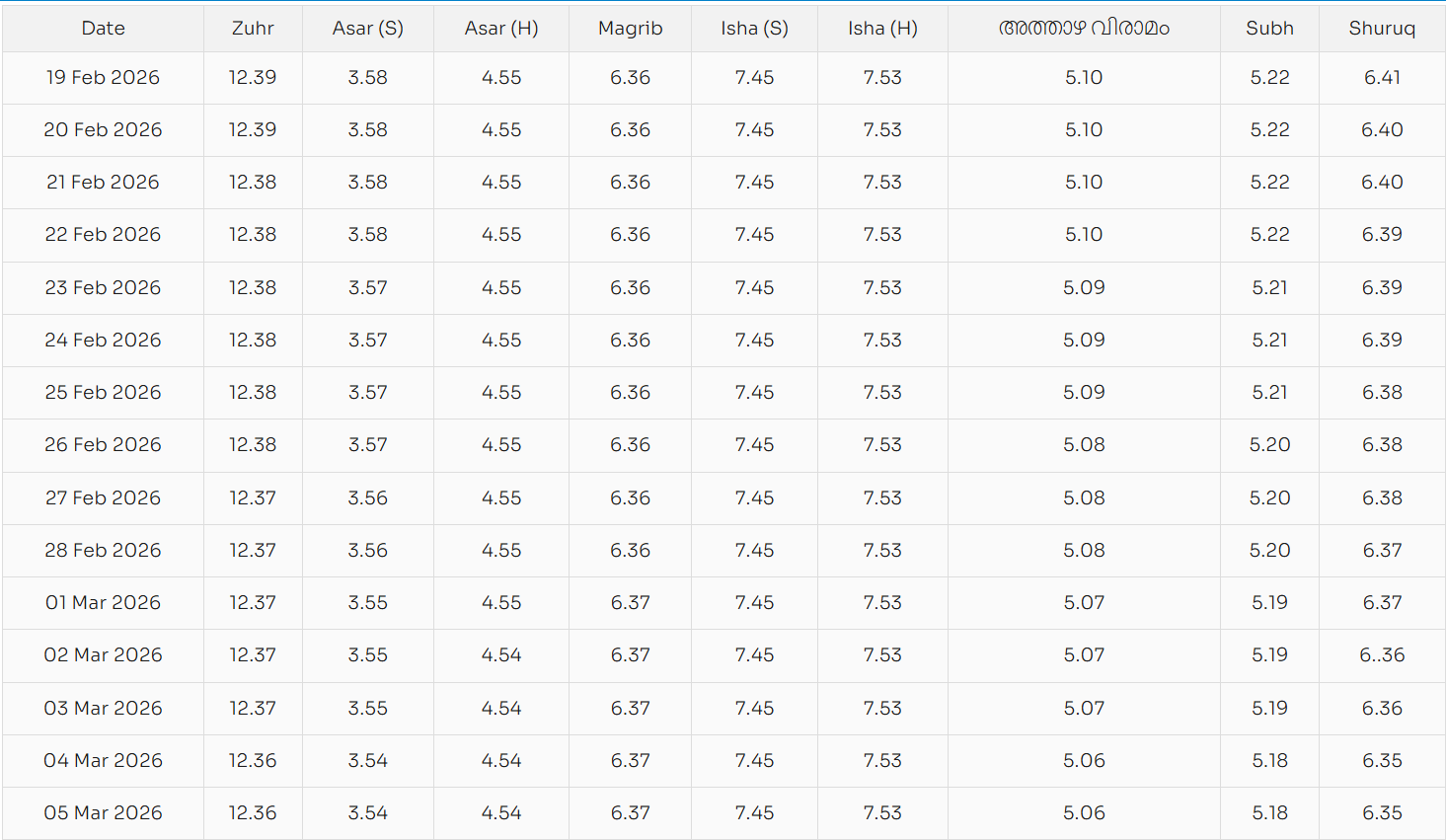
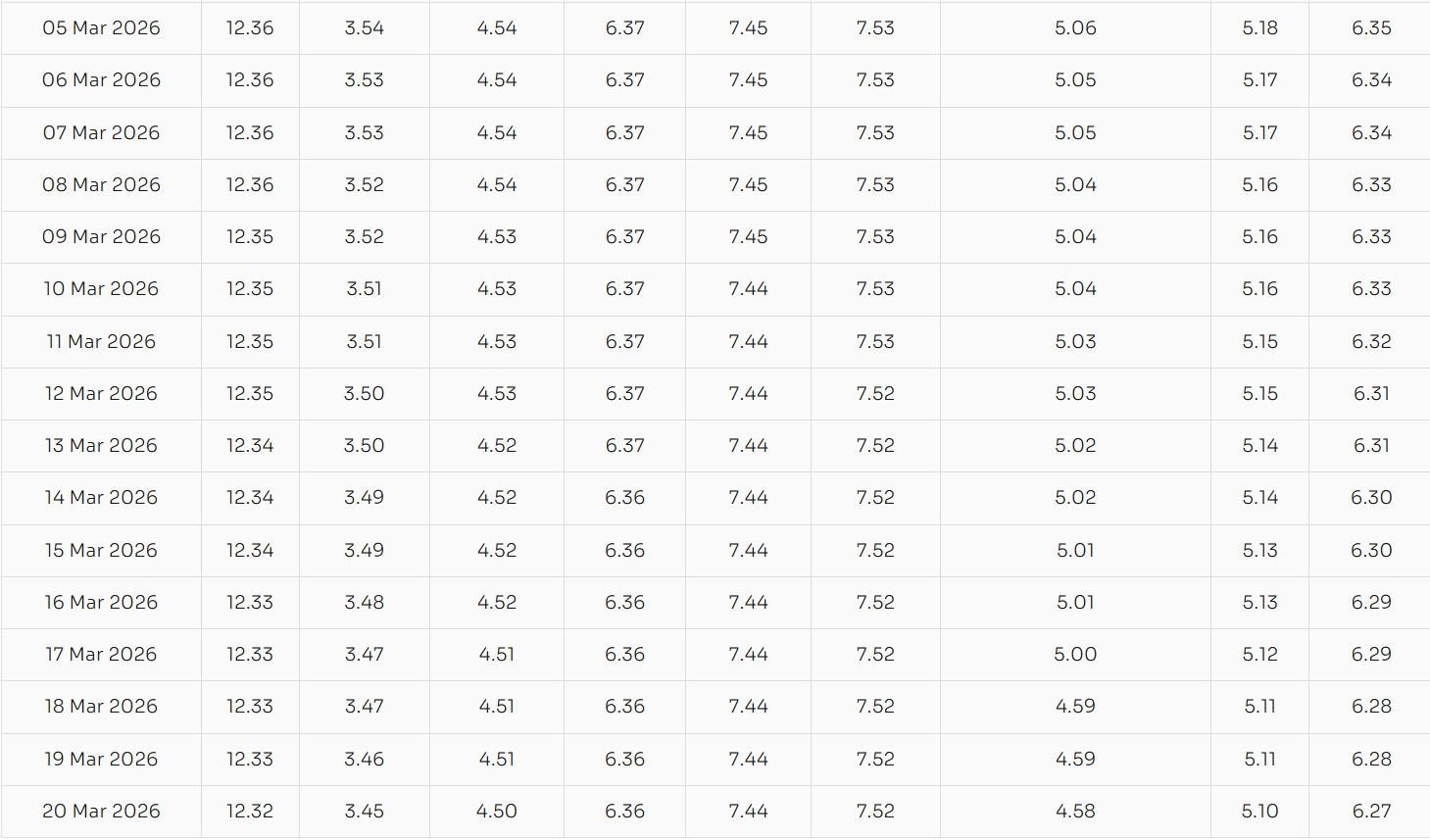
Malappuram Ramadan Calendar 2026 (Tentative)
Below is the Ramadan Calendar 2026 for Malappuram, Kerala. Please note that timings are based on astronomical calculations and may vary by a minute or two depending on your specific location within the district.
Day
Date (Feb/March)
Subah (Imsak/Fajr)
Maghrib (Iftar)
1
Feb 19
05:24 AM
06:35 PM
2
Feb 20
05:24 AM
06:35 PM
3
Feb 21
05:23 AM
06:35 PM
4
Feb 22
05:23 AM
06:35 PM
5
Feb 23
05:22 AM
06:36 PM
6
Feb 24
05:22 AM
06:36 PM
7
Feb 25
05:21 AM
06:36 PM
8
Feb 26
05:21 AM
06:36 PM
9
Feb 27
05:20 AM
06:36 PM
10
Feb 28
05:20 AM
06:36 PM
11
March 1
05:19 AM
06:37 PM
12
March 2
05:19 AM
06:37 PM
13
March 3
05:18 AM
06:37 PM
14
March 4
05:18 AM
06:37 PM
15
March 5
05:17 AM
06:37 PM
16
March 6
05:16 AM
06:37 PM
17
March 7
05:16 AM
06:37 PM
18
March 8
05:15 AM
06:37 PM
19
March 9
05:15 AM
06:38 PM
20
March 10
05:14 AM
06:38 PM
21
March 11
05:14 AM
06:38 PM
22
March 12
05:13 AM
06:38 PM
23
March 13
05:13 AM
06:38 PM
24
March 14
05:12 AM
06:38 PM
25
March 15
05:11 AM
06:38 PM
26
March 16
05:11 AM
06:38 PM
27
March 17
05:10 AM
06:38 PM
28
March 18
05:09 AM
06:38 PM
29
March 19
05:09 AM
06:38 PM
30
March 20
05:08 AM
06:38 PM
This Ramadan Calendar is a guide. Always follow the local Adhan from your neighborhood Masjid.
The Importance of 20 Rakath Tharaveeh: The Ahlusunnah Perspective
In the Shafi’i Madhhab, which is widely followed in Kerala by the Ahlusunnah (Sunni) community, the Tharaveeh prayer is a Sunnah Mu’akkadah (emphasized Sunnah). A core pillar of this practice is the performance of 20 Rakats.
Why 20 Rakats?
According to the Sunni scholars of the global Ahlusunnah Wal Jama’ah, the tradition of 20 Rakats was established during the Caliphate of Umar ibn al-Khattab (R).
Consensus (Ijma): The Sahaba (companions) agreed upon this number without objection, creating a consensus that has been preserved for over 1,400 years.
Historical Practice: Major Sunni authorities, including Imam Shafi’i, Imam Malik, and Imam Ahmad bin Hanbal, have upheld the 20-Rakat tradition as the standard for the Ummah.
Spiritual Depth: Performing 20 Rakats allows the believer to spend more time in the presence of Allah, listening to the recitation of the Holy Quran, which is usually completed over the month in many Masjids in Malappuram.
To omit these rakats or reduce them without a valid excuse is seen as missing out on a massive reservoir of rewards that only this Ramadan can offer.
Essential Deeds During the Month
While the Ramadan Calendar 2026 helps you track your fast, the “soul” of the month lies in your actions. Here are the key priorities for a Sunni Muslim:
1. Recitation of the Quran
Ramadan is the “Month of the Quran.” Try to complete at least one full recitation (Khatm). In Malappuram, it is common for families to gather after Subah or Asr to read together. To help you stay consistent with your goals this year, we have curated a special resource for you. You can now listen to a beautiful Quran audio collection featuring all 30 Juz for free. This high-quality quran recitation is perfect for listening during your commute or while relaxing at home, ensuring you stay connected to the divine words throughout the holy month.
2. Zakat and Sadaqah
This is the best time to calculate your Zakat. Charity given during this month is multiplied many times over. Look for local initiatives in Malappuram to help the needy in your own community.
3. Iftar and Suhoor
Sunnah dictates breaking the fast (Iftar) as soon as the sun sets with dates or water. Suhoor (the pre-dawn meal) should be delayed until just before Subah to gain the blessings mentioned by the Prophet (PBUH).
Preparing for the Last Ten Nights
As you check your Ramadan Calendar 2026, mark the last ten nights. These are the most sacred, containing Laylatul Qadr (The Night of Power), which is better than a thousand months. Many Masjids in Malappuram host I’tikaf (spiritual retreat) during these nights.
Making the Most of 2026
This Ramadan is a golden opportunity to reset our lives. By following the Ramadan Calendar 2026 and adhering to the rich traditions of the Ahlusunnah, we can ensure that our fasting is not just a physical struggle but a spiritual victory.
Let this Ramadan be the one where we strengthen our bonds with our families and our connection with the Creator. Remember to keep the entire Ummah in your prayers during the blessed hour of Iftar.
To understand the MCX gold and silver price today, you must first look at the ‘Global Why.’ As of mid-February 2026, we are witnessing a massive ‘valuation reset.’
The Profit-Booking Wave
January 2026 was a historic month. Silver surged by nearly 47% in a single month, driven by Middle East tensions and massive speculative buying. When prices hit record highs (nearly ₹4 lakh per kg for silver in some pockets), big institutional players did what they do best: they sold to lock in profits. This “long liquidation” is the primary reason for the sharp 20-21% crash we’ve seen in February.
The “Warsh” Effect and the US Dollar
The nomination of Kevin Warsh as the US Federal Reserve Chair has sent ripples through the commodity markets. His “hawkish” reputation suggests that US interest rates might stay higher for longer.
The Logic: Higher interest rates = Stronger US Dollar (DXY).
The Impact: Since gold and silver are priced in dollars globally (on TradingView), a strong dollar makes them more expensive for the rest of the world, leading to a drop in demand and price.
Industrial Demand vs. Safe Haven
Gold is a ‘Safe Haven’ (bought during fear), but silver is also an ‘Industrial Metal’ (used in solar panels and EVs). Currently, a slight cooling in global manufacturing data has hit silver harder than gold. This is why you see silver crashing 3-5% in a day while gold only slips 1%.
Global vs. Indian Level: TradingView vs. MCX
As a trader, you are likely toggling between TradingView and MCX. Understanding the difference is crucial for your “Basis” (the difference between spot and futures).
TradingView (Global Spot)
On TradingView, you track XAU/USD (Gold) and XAG/USD (Silver). These are “paper” prices reflecting the global sentiment in London and New York.
Pro Tip: Use TradingView for Technical Analysis. It has the best tools for RSI, MACD, and Fibonacci levels.
Watch the DXY: Always keep an overlay of the US Dollar Index. If the DXY is climbing, your long positions in gold are at risk.
MCX (Indian Futures)
The MCX gold and silver prices today are what you actually trade in India. It is influenced by the global spot but adds three ‘Indian’ layers:
Landed Cost: The cost of importing the metal.
Import Duty: The government’s tax on bullion.
USD-INR Exchange Rate: If the Rupee weakens, MCX prices might stay high even if global prices fall.
How to Evaluate Current Value: The Investor’s Checklist
Don’t just look at the ticker. Use these three metrics to see if the MCX gold and silver prices today are ‘cheap’ or ‘expensive.’
1. NSE I-NAV (For ETF Investors)
If you trade Gold BeES or other ETFs, the ‘Market Price’ can sometimes be misleading.
NAV (Net Asset Value): The value of the actual gold held by the fund at the end of the day.
I-NAV (Indicative NAV): The real-time value of that gold right now.
Action Step: If the ETF is trading at a price much higher than the I-NAV, you are paying an unnecessary premium. Wait for the price to align with the I-NAV before buying.
2. The “Repo Rate” Connection
The Reserve Bank of India (RBI) Repo Rate dictates the ‘opportunity cost’ of holding gold. When the RBI keeps rates high, investors prefer Fixed Deposits (FDs) over gold because gold pays no interest. If you hear news of a ‘Rate Cut’ in the future, that is usually the ‘Green Light’ for gold prices to rally.
3. Central Bank Bullion Buying
Watch the RBI’s monthly reports. Central banks are the ‘Whales’ of the market. If the RBI and China’s PBOC are consistently buying, they are creating a ‘Price Floor.’ Even if prices fall due to profit booking, central bank buying ensures they won’t stay down forever.
Practical Math: Converting Global Spot to MCX
Many business persons get confused by ‘Troy Ounces.’ Here is the simple formula to check if the MCX gold and silver prices today are in parity with the world:
Get the Spot Price: Let’s say Gold is $5,000/oz on TradingView.
Convert to Grams: Divide by 31.1035 (1 Troy Ounce = 31.1g).
Convert to INR: Multiply by the current USD-INR rate (e.g., ₹91).
Add Taxes: Add the current Import Duty (e.g., 6% or 15% depending on current policy) + 3% GST.
If the resulting number is much lower than the MCX price, the Indian market is overbought. If it’s higher, the MCX is offering a ‘discount.’
Daily Routine for Indian Traders (3-Step Process)
To master the MCX gold and silver price today, follow this 5-minute morning routine:
Check TradingView (7:00 AM): See how the US market closed. Look at the DXY and the US 10-year Treasury Yield.
Check MCX Open Interest (9:00 AM): Is the price falling on ‘High Volume’? That means a trend change. Is it falling on ‘Low Volume’? That’s just a temporary correction.
Monitor Geopolitical News: Use trusted links like Reuters or Bloomberg. A sudden headline about ‘Middle East Peace Talks’ can crash gold, while a ‘Trade War’ headline will send it soaring.
Strategy: Buying the Dip or Catching a Falling Knife?
Current market sentiment for February 16, 2026:
For Gold: The 24K price is hovering near ₹1,57,000. It has support near ₹1,53,000. For investors, a ‘staggered entry’ (buying 10% of your total intended amount every time it drops ₹1,000) is safer than a lump sum.
For Silver: It has hit ‘Lower Circuits’ recently. This means volatility is extreme. Avoid ‘Intraday’ trading unless you have deep pockets. For business persons, if MCX Silver is near ₹2,35,000 – ₹2,40,000, it is historically testing strong support levels.
FAQ: Your Top Questions Answered
1. How much is 1 kilo in silver today?
On the MCX, silver is currently trading in the ₹2.36 lakh to ₹2.45 lakh range (Futures). For physical silver, including GST and local premiums, expect to pay around ₹2.68 lakh to ₹2.75 lakh per kg depending on your city.
2. Why is the gold price falling?
Gold is reacting to a ‘Stronger Dollar’ and ‘Profit Booking.’ After a massive rally in January 2026, the market is simply cooling down. Additionally, lower-than-expected US inflation (CPI) has reduced the immediate need for gold as an “inflation hedge.”
3. What is the gold and silver rate today for 24K?
The national average for 24K Gold is approximately ₹1,57,740 per 10 grams (as of Feb 16, 2026). Silver is roughly ₹274 per gram.
4. Where to find live international and MCX prices?
The MCX gold and silver price today might look scary due to the recent ‘crash,’ but for the disciplined investor, this is where wealth is made. The 20% correction in silver has removed the ‘froth’ from the market, making it more attractive for long-term accumulation.
Remember: Never trade without a ‘Stop Loss’ on MCX, and always check the I-NAV before buying any Gold/Silver ETF.
AFG vs UAE T20 On the morning of February 16, 2026, the Arun Jaitley Stadium in New Delhi became the epicenter of a frantic struggle for survival in Group D of the ICC Men’s T20 World Cup. The contest between Afghanistan and the United Arab Emirates (UAE) was not merely a scheduled fixture in the global cricketing calendar; it was a collision of two diverging narratives within the Asian cricketing ecosystem. For Afghanistan, a Full Member nation with a semi-final pedigree from the 2024 edition, the tournament had curdled into a sequence of heartbreaks and near-misses. Sitting winless after two matches, including a historic and psychologically devastating “Double Super Over” loss to South Africa, Rashid Khan’s men entered the arena with their World Cup dreams hanging by a thread. Conversely, the UAE arrived with the buoyant energy of a rising Associate power, fresh from a gritty victory over Canada that validated their developmental structures and placed them in genuine contention for a Super 8 berth.
This comprehensive report provides an exhaustive analysis of Match 28 (AFG vs UAE T20), dissecting the pre-match geopolitical and sporting context, the psychological baggage carried by the Afghan squad, and the tactical nuances of the encounter itself. Through a detailed reconstruction of the first innings, analyzing ball-by-ball data and player performance, we explore how Afghanistan attempted to stifle a spirited Emirati lineup despite the absence of their premier pacer, Fazalhaq Farooqi. Furthermore, we examine the broader implications of this rivalry, which mirrors the shifting tectonic plates of cricket in the Middle East and South Asia.
The Tournament Landscape and Pre-Match Context (AFG vs UAE T20)
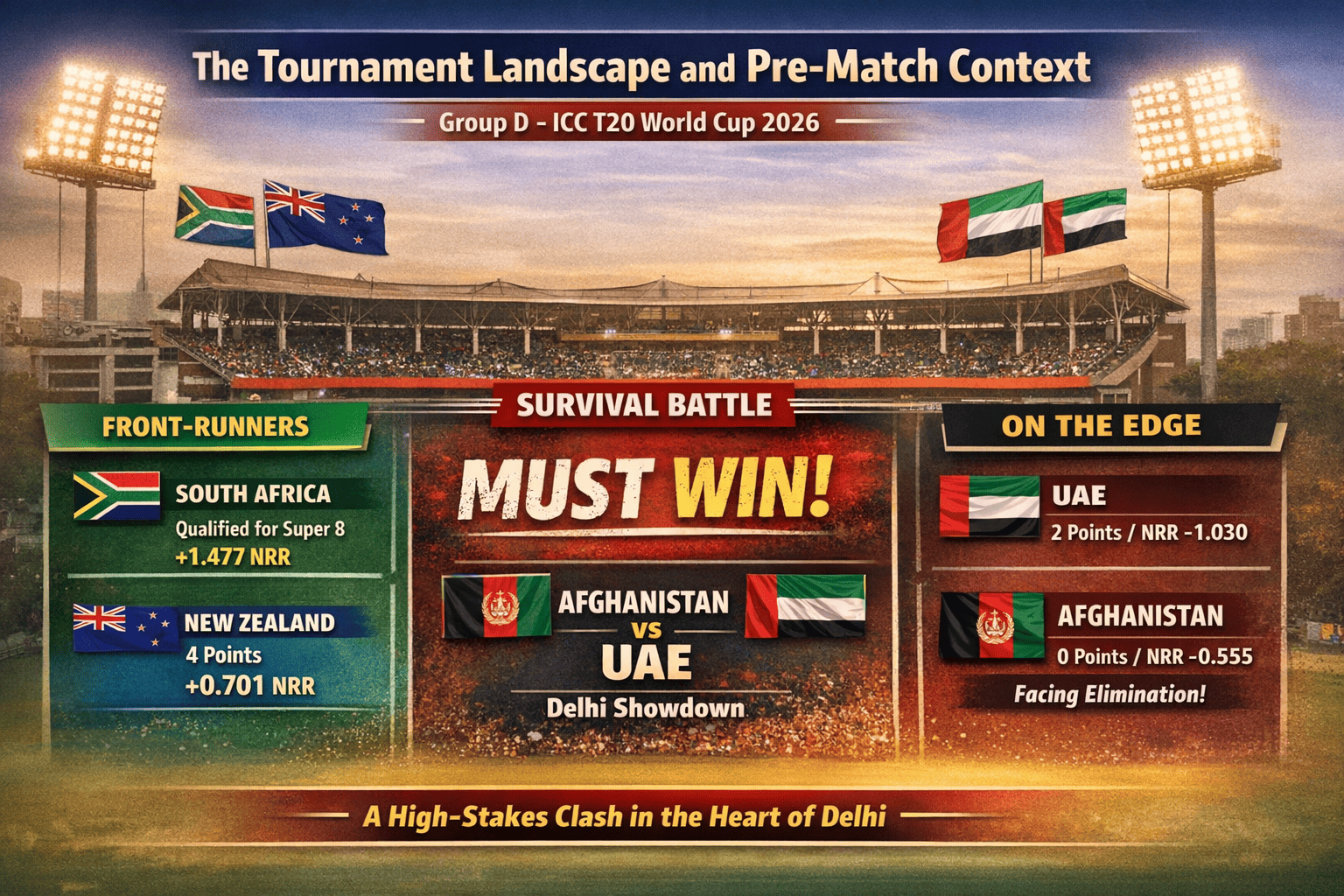
To understand the ferocious intensity of this Monday morning clash, one must first navigate the turbulent waters of Group D, arguably the “Group of Death” for the Associate nations involved. The stakes in Delhi were defined not just by the points on offer but by the mathematical precipice both teams faced.
The Group D Arithmetic: Survival of the Fittest
As the sun rose over the hazy skyline of the Indian capital, the Group D standings painted a stark picture of disparity and desperation. South Africa had already stamped their authority on the group, securing qualification for the Super 8s with three consecutive victories and a formidable Net Run Rate (NRR) of +1.477. This left only one automatic qualification spot available, with New Zealand holding the prime position on 4 points.
The equation for the chasing pack was unforgiving:
New Zealand (4 points, NRR +0.701): Sitting comfortably but not safely. A slip-up could open the door.
UAE (2 points, NRR -1.030): Occupying the third spot. A win against Afghanistan would elevate them to 4 points, level with the Black Caps, creating a high-pressure scenario where NRR would decide the second qualifier.
Afghanistan (0 points, NRR -0.555): The 2024 semi-finalists found themselves in the unfamiliar territory of the wooden spoon battle. To stay alive, they required not just a win, but a comprehensive one to repair their NRR and bridge the gap to New Zealand.
For Afghanistan, the match against the UAE was a de facto knockout game. A loss would mathematically eliminate them from Super 8 contention, rendering their final group game against Canada a dead rubber—a humiliating prospect for a team that had established itself as a top-tier T20 outfit.
The Psychological Baggage: Afghanistan’s “Double Super Over” Trauma
The mental state of the Afghan squad entering this match cannot be overstated. Just days prior, they had participated in a match that defied the conventions of the sport and pushed the physical limits of the players involved. The encounter against South Africa at the Narendra Modi Stadium in Ahmedabad will go down in history as the “Match of the Century,” but for the Afghan players, it remains a scar.
The details of that match provide the context for the tension visible in Delhi:
The Tie: Chasing a formidable 187, Afghanistan was powered by a gladiatorial knock of 84 off 42 balls from Rahmanullah Gurbaz, tying the game on the final ball.
Super Over 1: In a display of nerve-shredding parity, both teams scored exactly 17 runs in the first Super Over.
Super Over 2: The unprecedented second Super Over saw South Africa plunder 23 runs. Afghanistan responded with 19, falling agonizingly short by 4 runs.
This defeat was more damaging than a thrashing. It eroded the team’s belief in their ability to close out tight games. The physical fatigue of a double-over thriller, combined with the emotional crash of coming so close yet failing, created a “hangover” effect. Questions swirled about their resilience: Could Gurbaz recover from the heartbreak of his heroic failure? Could Rashid Khan rally a troop that felt the universe was conspiring against them? The Delhi match was their opportunity to answer these questions, to exorcise the ghosts of Ahmedabad.
The Emirati Ascendancy: A Narrative of Belief
While Afghanistan licked its wounds, the UAE camp was surging with a newfound belief. Their tournament had begun disastrously with a 10-wicket demolition by New Zealand, a result that threatened to confirm the skepticism surrounding Associate nations at major events. However, their response against Canada was a masterclass in resilience.
The victory over Canada was significant not for the margin (5 wickets) but for the manner in which it was achieved. It was not a victory dependent on their talismanic captain, Muhammad Waseem. Instead, it was engineered by two young, India-born talents who had found a cricketing home in the Emirates:
Aryansh Sharma: The wicketkeeper-batter anchored the chase with an unbeaten 74 off 53 balls, displaying a maturity that belied his age.
Sohaib Khan: His explosive 51 off 29 balls provided the necessary acceleration, proving that the UAE batting lineup possessed depth and power beyond the top order.
This win did more than put points on the board; it validated the UAE’s high-performance program and the impact of the International League T20 (ILT20). Players like Junaid Siddique, who claimed a five-wicket haul against Canada, looked comfortable on the big stage, having rubbed shoulders with the world’s best in franchise cricket. They arrived in Delhi not as underdogs hoping for a miracle, but as competitors expecting to win.
Historical Rivalry and Geopolitical Dynamics
The clash between Afghanistan and the UAE (AFG vs UAE T20) is layered with history that extends beyond the boundary rope. It is a rivalry rooted in the shared geography of cricket’s development in the Middle East and the complex brotherhood of two nations whose cricketing paths have been intertwined for decades.
The “Home” Away from Home
For years, the UAE served as the adopted home of Afghan cricket. Exiled by war and instability, Afghan players honed their skills on the concrete wickets of refugee camps in Pakistan but played their international cricket in the grand stadiums of Sharjah, Dubai, and Abu Dhabi. The Emirates Cricket Board (ECB) hosted Afghanistan for years, providing the infrastructure that allowed the “Blue Tigers” to rise from Division 5 of the World Cricket League to Full Member status.
This history creates a unique dynamic. The Afghan players know the UAE conditions—and often the UAE players—intimately. However, for a long time, the relationship was hierarchical: Afghanistan was the big brother, the success story, while the UAE remained the stagnant Associate.
The Closing Gap: Head-to-Head Analysis
The statistics reflect Afghanistan’s historical dominance, but a closer look reveals a tightening contest.
Total Matches Played (T20I): 14
Afghanistan Wins: 11
UAE Wins: 3
Win Percentage (AFG): ~79%.
However, the “Associate gap” has been shrinking rapidly in the 2023-2025 cycle.
December 2023: UAE defeated Afghanistan by 11 runs in a T20I, a shock result that signaled their rising competence.
September 2025: In a T20I Tri-Series in Sharjah, Afghanistan won by a mere 4 runs, defending 170 in a nail-biter that went down to the final ball.
Competitive Trend: While Afghanistan leads 4-1 in the last five encounters, the margins of victory have decreased. The days of Afghanistan rolling over the UAE for sub-100 scores are largely gone. The UAE batters, exposed to high-quality spin in the ILT20, are no longer “bamboozled” by mystery spin in the way they were a decade ago.
The ILT20 Effect
The emergence of the ILT20 (International League T20) in the UAE has been a catalyst for this shift. Local UAE players are now mandated to be part of the playing XIs in the league, forcing them to compete against and alongside elites like Trent Boult, Andre Russell, and indeed, Rashid Khan and Fazalhaq Farooqi. This exposure has demystified the “superstar” aura of the Afghan players. When Sohaib Khan faces Rashid Khan in Delhi, he is facing a bowler he has likely analyzed, played against, or even shared a dressing room with in the franchise circuit.
Venue Analysis – The Arun Jaitley Stadium (AFG vs UAE T20)
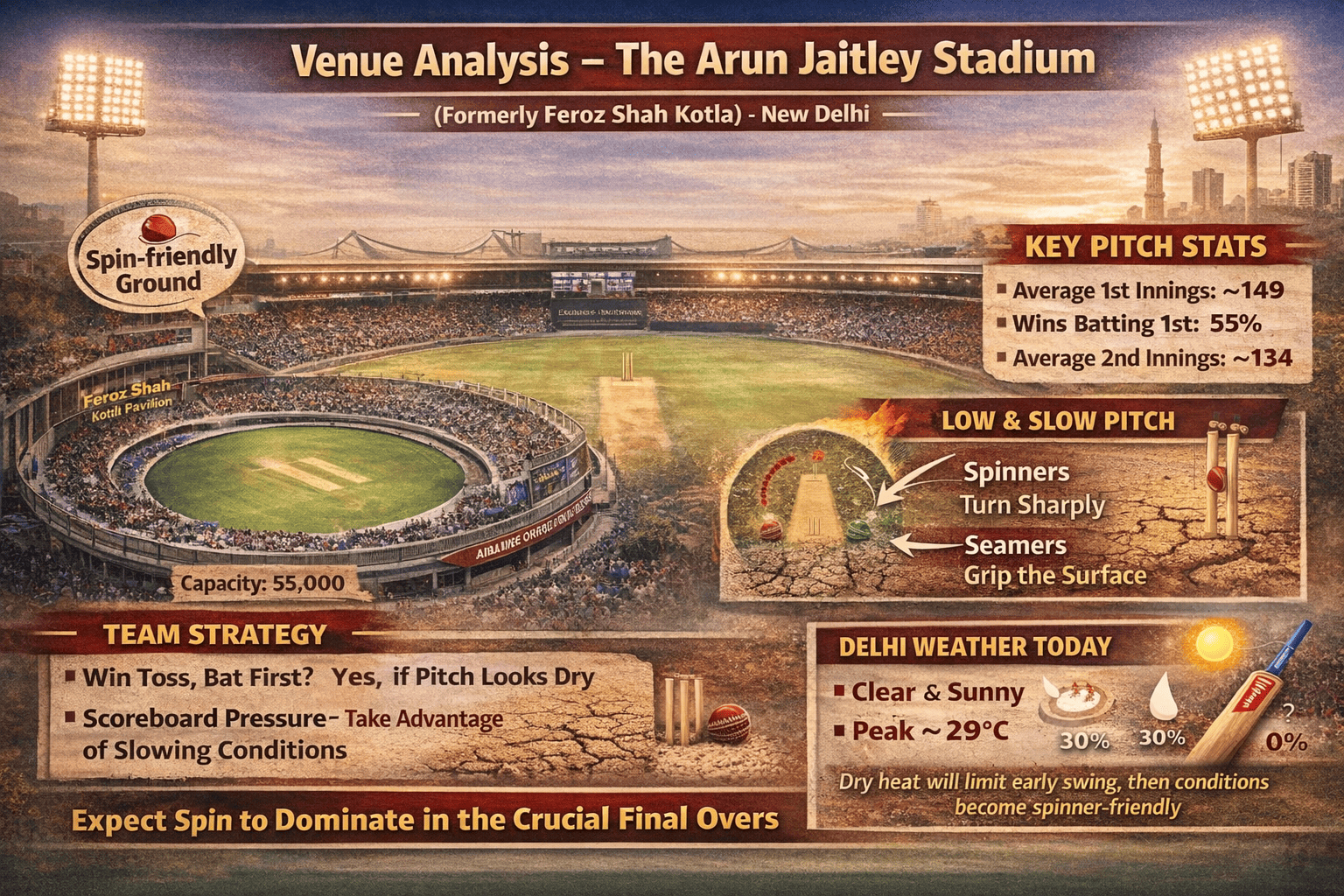
The stage for this drama was the Arun Jaitley Stadium (formerly Feroz Shah Kotla) in New Delhi. Historically one of India’s oldest grounds, it possesses a unique character that significantly influences team selection and tactics.
Pitch Characteristics: The Spinner’s Paradise?
Traditionally, the Delhi pitch is low and slow, favoring spinners and cutters. The soil composition often leads to the wicket breaking up as the game progresses, making stroke-making difficult in the latter half of the second innings.
Average 1st Innings Score: ~149.
Average 2nd Innings Score: ~134.
Key Stat: Teams winning the toss often prefer to chase in T20s to gauge the target, but at the Kotla, batting first and putting runs on the board (scoreboard pressure) is a viable strategy if the pitch is particularly dry.
However, recent IPL seasons and the 2023 ODI World Cup showed a different side to Delhi—flatter tracks with smaller boundaries leading to high scores. The uncertainty of which “version” of the pitch would appear added a layer of intrigue to the toss.
Weather Conditions
The forecast for February 16, 2026, was quintessential Delhi winter-spring transition:
Temperature: Peak of 29°C.
Sky: Clear and sunny.
Humidity: Moderate.
Rain Probability: 0%. The dry heat and lack of cloud cover meant that swing would be limited to the very early overs, after which the spinners would dictate proceedings. The absence of dew (being a day game) meant the captains did not have to worry about the ball getting wet in the second innings.
Match Day – Team News and Tactical Shifts (AFG vs UAE T20)
As the captains walked out for the toss at 10:30 AM IST, the atmosphere was tense. The stands were filling up, largely with Afghan students and expatriates living in Delhi, creating a partisan atmosphere that effectively made this a home game (AFG vs UAE T20) for Afghanistan.
The Toss: Rashid’s Defensive Gamble
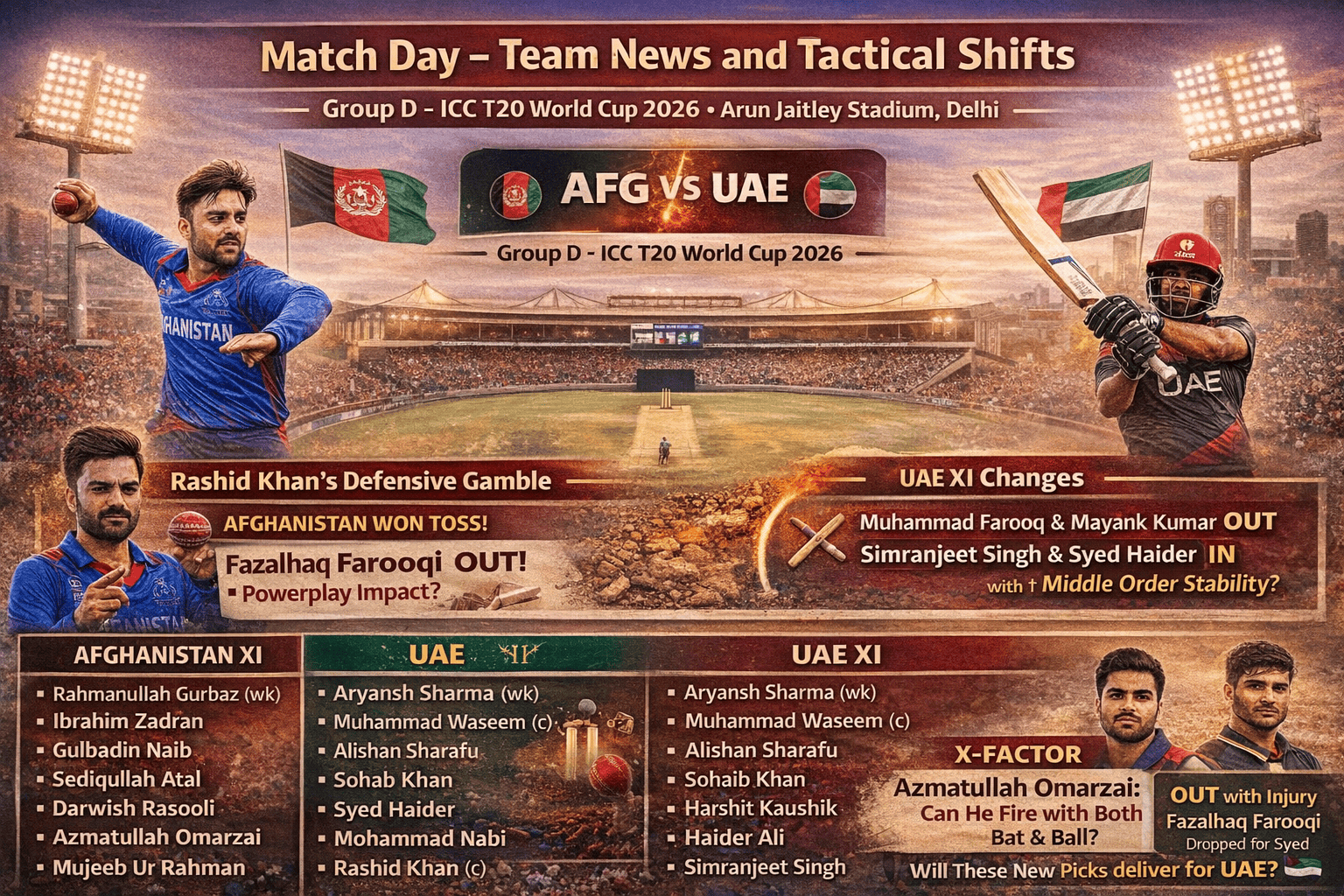
Rashid Khan won the toss and elected to bowl first.
The Rationale: This decision was defensive. Coming off the trauma of the South Africa match, where they failed to defend/tie in the Super Over, Rashid likely wanted to control the controllables. By bowling first, he could unleash his spinners on a fresh-ish wicket and chase a known target, removing the anxiety of setting a total.
UAE’s Perspective: UAE captain Muhammad Waseem admitted he would have batted first as well, hoping to put runs on the board and let the pressure of the chase weigh on the fragile Afghan batting lineup.
Team News: The Farooqi Blow
The headline news from the toss was a significant setback for Afghanistan. Fazalhaq Farooqi, their premier left-arm pacer and arguably the best new-ball bowler in the tournament, was ruled out of the playing XI.
Impact: Farooqi is the linchpin of Afghanistan’s powerplay strategy. His ability to swing the ball back into right-handers and hold a tight line is crucial. Without him, the attack lacked its spearhead.
Replacement:Ziaur Rahman Sharifi was drafted in. Ziaur is a different type of bowler—hit-the-deck hard, relying on seam movement rather than swing. While a capable replacement, he lacks Farooqi’s terror factor.
Afghanistan Playing XI:
Rahmanullah Gurbaz (wk)
Ibrahim Zadran
Gulbadin Naib
Sediqullah Atal
Darwish Rasooli
Azmatullah Omarzai
Mohammad Nabi
Rashid Khan (c)
Mujeeb Ur Rahman
Noor Ahmad
Ziaur Rahman.
UAE Playing XI:
Aryansh Sharma (wk)
Muhammad Waseem (c)
Alishan Sharafu
Sohaib Khan
Syed Haider (In for Mayank Kumar)
Harshit Kaushik
Muhammad Arfan
Haider Ali
Simranjeet Singh (In for Muhammad Farooq)
Junaid Siddique
Muhammad Jawadullah.
The UAE made two changes, bringing in Syed Haider and Simranjeet Singh, likely to bolster their middle-order batting against spin and add a spin option of their own.
The First Innings – A Tactical Autopsy
The first innings was a fascinating study in momentum swings, showcasing the gap in experience between the two sides. While the UAE showed flashes of brilliance, Afghanistan’s ability to take wickets at critical junctures kept them in control.
The Powerplay: Omarzai Fills the Void (Overs 1-6)
With Farooqi missing, the pressure was on Azmatullah Omarzai to deliver with the new ball. He did not disappoint.
0.4 Overs: In the very first over, Omarzai struck a massive blow. Aryansh Sharma, the hero of the Canada win, was trapped for a duck (0 off 4 balls).
Analysis: Sharma is the anchor of the UAE innings. Removing him before he could settle exposed the middle order immediately. It was a perfect start for Afghanistan, calming the nerves after the toss.
2.0 Overs: The UAE captain, Muhammad Waseem, known for his explosive hitting, tried to counter-attack. He scored a quick 10 off 6 balls, including two boundaries, but his aggression was his undoing. Facing the mystery spin of Mujeeb Ur Rahman, Waseem was trapped LBW.
Score at 2.0 Overs: 13/2.
At this stage, the UAE was staring down the barrel. Losing both openers inside 2 overs is often a death knell in T20 cricket, especially against a team with the bowling depth of Afghanistan. The Afghan fans in the stadium roared, sensing a quick rout.
The Resistance: Sharafu and Sohaib Khan (Overs 3-11)
Just as a collapse seemed imminent, the UAE found resilience in the form of Alishan Sharafu and Sohaib Khan.
Stabilizing the Ship: The pair eschewed risky shots initially, focusing on rotating the strike against Ziaur Rahman and Naveen-ul-Haq (Note: Naveen is listed in some squads, but Ziaur played; the text confirms Ziaur bowled).
Counter-Attack: Once settled, they began to attack. Sohaib Khan, continuing his form from the Canada match, took the attack to the spinners. He used his feet well against Noor Ahmad, disrupting the spinner’s length.
The Partnership: They constructed a vital stand of 84 runs. This partnership brought the UAE back into the game, pushing the score past 90 and setting a platform for a 160+ total.
The Turning Point: Mujeeb’s Return (Overs 11-12)
Cricket is a game of moments, and the 12th over was the defining moment of the innings. Rashid Khan brought Mujeeb Ur Rahman back into the attack to break the stand.
11.2 Overs: Mujeeb tossed one up, enticing Sharafu into a big shot. Sharafu backed away to hit over long-off but failed to get the elevation. Ibrahim Zadran took a comfortable catch near the boundary.
Dismissal: Alishan Sharafu c Ibrahim Zadran b Mujeeb Ur Rahman 40 (31 balls).
Score: 97/3.
This wicket was the catalyst for the second collapse. Sharafu was the set batter who could have accelerated at the death. His dismissal exposed the lower-middle order to the high-pressure death overs.
The Middle-Order Slide (Overs 13-16)
Following Sharafu’s departure, the Afghan bowlers tightened the noose.
Syed Haider’s Cameo: The new man, Syed Haider, tried to keep the momentum going. He struck a six and a four in a brief stay of 13 runs off 10 balls, but was cleaned up by the returning Azmatullah Omarzai.
Double Strike: In the same spell, Omarzai removed Harshit Kaushik for a duck (0 off 3 balls), caught by Gurbaz.
The Hit Wicket: The pressure exerted by Rashid Khan resulted in a comical yet tragic dismissal for UAE. Muhammad Arfan, attempting to improvise a reverse sweep against the Afghan captain, lost his balance and stepped onto his stumps. Hit Wicket b Rashid Khan 0 (2 balls).
State of Play at 16.0 Overs
As the match headed into the final four overs, the scorecard read:
Score: 121/6.
Run Rate: 7.56.
Key Batter: Sohaib Khan was still at the crease, batting beautifully on 53 off 38 balls*.
Bowling Figures:
Azmatullah Omarzai: 3 wickets for 10 runs (3.0 overs) – A match-winning spell.
Mujeeb Ur Rahman: 2 wickets for 31 runs (4.0 overs).
Rashid Khan: 1 wicket for 24 runs (4.0 overs).
The UAE had squandered a brilliant platform. From 97/2, they had lost 4 wickets for just 24 runs. The projected score dropped from 170 to a scrappy 145-150.
Statistical Deep Dive and Player Performance
The first innings provided a wealth of statistical insights that highlight the strengths and weaknesses of both sides.
Azmatullah Omarzai: The Silent Assassin
While Rashid Khan and Mujeeb grab the headlines, Azmatullah Omarzai has quietly become Afghanistan’s most valuable asset in conditions that offer a hint of movement.
Spell Analysis: His 3/10 included the prize wicket of Aryansh Sharma and two middle-order scalps that halted the UAE charge.
Milestone: With the wicket of Sharma, Omarzai reached his 50th T20I wicket, a testament to his consistency.
Tactical Importance: By taking wickets with the old ball (overs 14-15), he solved Afghanistan’s chronic death-bowling issue, usually a vulnerability when Farooqi is absent or bowled out early.
Sohaib Khan: The UAE’s New Star
Sohaib Khan’s innings of 53* (at the 16-over mark) was a masterclass in controlled aggression.
Consistency: This was his second consecutive 50+ score, following his 51 vs Canada.
Technique: His ability to sweep the spinners and hit down the ground against the pacers showed a complete game.
Significance: In a team often reliant on Waseem, Sohaib has emerged as the reliable middle-order pivot. His wagon wheel (inferred) showed strength in the ‘V’ and the sweep zone, making it hard for Rashid to set a field.
Mujeeb Ur Rahman: The Partnership Breaker
Mujeeb’s figures of 2/31 might look expensive compared to Omarzai, but his impact was arguably equal.
Economy vs Impact: He went for 7.75 runs per over, but he took the wickets of the two set batters (Waseem and Sharafu). In T20 cricket, breaking a partnership is often worth 20 runs.
Variations: He used his carrom ball effectively to confuse the right-handers, forcing the false shot from Sharafu.
Qualification Scenarios and Future Outlook In Light Of (AFG vs UAE T20)
As the match progresses into the second innings, the implications for the Group D table are massive.
Current Live Standings (Group D):
Team
Played
Won
Lost
Points
NRR
Status
South Africa
3
3
0
6
+1.477
Qualified
New Zealand
3
2
1
4
+0.701
In Contention
UAE
2
1
1
2
-1.030
In Contention
Afghanistan
2
0
2
0
-0.555
Critical
Canada
2
0
2
0
-1.526
Near Elimination
Afghanistan Chases Successfully
If Afghanistan chases down the target (likely ~150):
Points: They move to 2 points, level with the UAE (and potentially Canada if they lose their next game).
NRR Implication: A quick chase (e.g., in 16-17 overs) would significantly boost their NRR, possibly overtaking UAE and moving closer to New Zealand’s +0.701.
Outlook: They would stay alive. They would then need to beat Canada in their final game and hope New Zealand loses to the UAE or that run-rate math works in their favor.
UAE Defends the Total
If the UAE wins:
Points: They move to 4 points, level with New Zealand.
Outlook: This would be a seismic result. Afghanistan would be eliminated. UAE would be in a prime position to qualify for the Super 8s, needing only to avoid a heavy defeat in their final game (or win it) to potentially knock out New Zealand on NRR or points.
History: It would mark the first time an Associate nation from the Middle East qualified for the Super 8 stage of a T20 World Cup, validating the expansion of the game.
Second Innings Preview – The Chase
The stage is set for a thrilling chase. Afghanistan needs approximately 150 runs to stay in the World Cup.
The Key Battle:Rahmanullah Gurbaz vs Junaid Siddique. Gurbaz is the aggressor; Siddique is the wicket-taker (5-fer vs Canada). The first 6 overs will decide the game. If Siddique removes Gurbaz early, the panic in the Afghan camp—stemming from the South Africa loss—will be palpable.
The Spin Factor: The UAE has a capable spin attack. Can they utilize the drying Delhi pitch to strangle the Afghan middle order like Afghanistan did to them?
Verdict: Afghanistan enters the break as favorites due to their batting depth and experience, but the “scoreboard pressure” of a must-win game can do strange things to even the best teams.
A Watershed Moment
Regardless of the final result, Match 28 of the 2026 T20 World Cup will be remembered as a pivotal moment in the history of Asian cricket. For Afghanistan, it is a test of character—can they bounce back from the lowest point (the SA loss) to keep their dreams alive? For the UAE, it is a statement of intent—proving that they are no longer just the hosts of cricket, but serious competitors on the field.
The Arun Jaitley Stadium, with its history of witnessing cricketing attrition, provided the perfect backdrop for this struggle. As the players walked off after the first innings, the game was poised on a knife-edge: Afghanistan holding the upper hand tactically, but UAE holding the psychological card of having nothing to lose and everything to gain.
The Indian automotive sector is currently navigating a period of unprecedented disruption, characterized by a rapid pivot toward electrification and a heightening of safety standards. At the forefront of this movement is Tata Motors, which has strategically utilized its dominant market share—reaching 43.35 percent of the electric passenger vehicle segment in January 2026—to redefine urban mobility. The newly released 2026 Tata Punch EV Facelift represents a critical evolution in the micro-SUV category, being the primary vehicle built upon the advanced acti. ev (Advanced Connected Tech-Intelligent Electric Vehicle) architecture. Officially unveiled for launch on February 20, 2026, this model seeks to address the multifaceted demands of the modern Indian consumer: safety, status, sustainability, and technological sophistication.
The Structural Foundation: The acti.ev Architecture
The 2026 Tata Punch EV is not merely a conversion of an existing internal combustion engine (ICE) platform but is built on a dedicated Gen 2 pure-electric architecture. This engineering choice has profound implications for the vehicle’s dynamics and packaging. By utilizing a dedicated EV platform, engineers have managed to integrate the battery pack as a structural component of the chassis, resulting in a significantly lower center of gravity compared to the petrol-powered Punch. This translates into improved handling characteristics and reduced body roll during high-speed maneuvers.
The acti.ev platform allows for a flat floor, which maximizes cabin volume and provides a sense of spaciousness often absent in micro-SUVs. Furthermore, the modular nature of the architecture supports future-ready technologies, including cloud-connected diagnostics and advanced thermal management systems that are essential for maintaining battery health in the extreme climatic conditions prevalent in regions like Kerala and Northern India. The transition to Gen 2 architecture also facilitates the inclusion of a “frunk” (front trunk) in some configurations, although the Punch EV prioritizes an optimized front-end for pedestrian safety and crumple zones.
Aesthetic Evolution and Exterior Design Philosophy
The 2026 facelift introduces several subtle yet impactful changes to the exterior, moving the Punch EV closer to the design language of Tata’s larger premium SUVs like the Nexon EV and Harrier EV. The visual updates are concentrated at the front fascia, emphasizing the vehicle’s electric identity through a cleaner and more structured appearance.
The Front Fascia and Lighting Signature
In the updated 2026 model, the black plastic strip that previously connected the headlamps has been removed in favor of a sealed-off grille area. This modification enhances the aerodynamic profile of the car while providing a more contemporary and minimal look. The daytime running lamps (DRLs) have been redesigned to include a full-width LED light bar that spans the bonnet line, creating a distinctive lighting signature that is visible from a distance.
The main headlamp units are now separate and sit lower on the bumper, integrated into revised housings that feature sharper creases and more pronounced contours. The lower section of the front bumper includes a revised air dam and a redesigned skid plate, further emphasizing the vehicle’s rugged, urban-focused SUV stance. These changes collectively differentiate the 2026 EV facelift from both its predecessor and the standard petrol-powered Punch models currently on the road.
Color Palette and Aero Enhancements
Tata Motors has introduced new exterior color options to coincide with the 2026 launch. Most notable is the Sunlit Yellow with a contrasting black roof, a combination borrowed from the Harrier, which highlights the vehicle’s revised styling details. Additionally, a Supernova Copper hue and Pure Grey have been added to the catalog.
The profile of the vehicle remains synonymous with the nameplate’s “boxy” and upright proportions, ensuring high ground clearance of 190 mm—a vital metric for navigating the pothole-ridden or flooded roads often found in monsoon-hit states like Kerala. To further efficiency, the 2026 model receives newly designed aero-focused alloy wheels, likely sized at 195/60 R16, which minimize air turbulence around the wheel arches.
Exterior Dimension
Measurement
Overall Length
3857 mm
Overall Width
1742 mm
Overall Height
1633 mm
Wheelbase
2445 mm
Ground Clearance (Unladen)
190 mm
Data derived from.
Interior Refinement and Technological Integration
The cabin of the 2026 Tata Punch EV Facelift serves as the primary interface for its advanced technological suite. While the overall layout remains evolutionary, the introduction of premium materials and high-resolution displays brings a “segment-above” feel to the micro-SUV.
The Digital Cockpit and Infotainment
The most significant interior update is the inclusion of a larger 12.3-inch touchscreen infotainment system in the higher-spec Empowered variants. This screen runs an updated version of Tata’s software UI, which is designed to be more intuitive and responsive. It supports wireless Apple CarPlay and Android Auto, along with the Arcade.ev suite, which allows for in-car video streaming and gaming during charging sessions.
Accompanying the infotainment screen is a 10.25-inch fully digital instrument cluster. This display provides critical information to the driver, including real-time energy flow, battery state of charge (SOC), and navigation maps directly in the line of sight. The steering wheel has been upgraded to a twin-spoke design featuring an illuminated central logo, further aligning the Punch EV with the premium aesthetics of the Nexon and Curvv lineups.
Comfort and Convenience Amenities
To maintain its competitive edge in the sub-15 lakh segment, Tata has equipped the 2026 Punch EV with features previously reserved for luxury vehicles:
Ventilated Front Seats: A critical addition for the humid Kerala climate, significantly enhancing long-distance comfort.
Wireless Charging: A dedicated pad for inductive smartphone charging, reducing cable clutter in the cockpit.
Auto-Dimming IRVM: Enhances night driving safety by automatically reducing glare from trailing vehicles.
Voice-Enabled Sunroof: A single-pane electric sunroof that can be controlled via voice commands, a highly popular feature among Indian car buyers.
Air Purifier: Integrated system with AQI display, ensuring a healthier cabin environment in polluted urban centers.
Performance, Battery, and Charging Dynamics
The 2026 Tata Punch EV Facelift continues the strategy of offering two distinct battery and performance tiers: the Standard (Medium Range) and the Long Range (LR) versions. This allows Tata to cater to both budget-conscious city dwellers and those who require a primary vehicle capable of inter-city travel.
Battery and Motor Specifications
The Standard variant utilizes a 25 kWh Lithium-ion battery pack, while the Long Range variant is powered by a 35 kWh unit. Both variants use a Permanent Magnet Synchronous Motor (PMSM) driving the front wheels, but with different power outputs to match their respective battery capacities.
Metric
Standard (Medium Range)
Long Range (LR)
Battery Capacity
25 kWh
35 kWh
Peak Power Output
82 hp (60 kW)
122 hp (90 kW)
Peak Torque Output
114 Nm
190 Nm
0-100 km/h (Claimed)
13.5 Seconds
9.5 Seconds
Top Speed
120 km/h
140 km/h
Claimed MIDC Range
315 km
421 km
Data synthesized from.
Charging Efficiency and Time Analysis
A significant upgrade for the 2026 Long Range model is the improved charging rate. The LR variants can now support a 1.2 C charging rate, which allows the 35 kWh battery to go from 10 percent to 80 percent in just 40 minutes when using a 50 kW DC fast charger. This is a substantial improvement for users who frequently use highway charging networks. The Standard variant takes approximately 56 minutes for a similar charge level on a 50 kW DC charger.
For residential or commercial AC charging, Tata offers two options. The 3.3 kW AC wall box charger is the standard inclusion, while a faster 7.2 kW AC charger is available for an additional cost (approximately ₹50,000) or included in higher trims.
Charger Specification
25 kWh Battery (10-100%)
35 kWh Battery (10-100%)
15A Portable Charger
~9.4 Hours
~13.5 Hours
3.3 kW AC Wall Box
~9.4 Hours
~13.5 Hours
7.2 kW AC Fast Charger
~3.6 Hours
~5.0 Hours
50 kW DC Fast Charger
~56 Minutes (10-80%)
~40 Minutes (10-80%)
Data derived from.
Real-World Range Realities and the “800 km” Rumor
One of the most frequent queries regarding the Tata Punch EV—as seen in search trends and “People also ask” queries—concerns the possibility of an 800 km range. Systematic research into global automotive trends for 2026 suggests that while 800 km ranges are being targeted by high-end manufacturers like Toyota and BMW for their flagship luxury models, no micro-SUV in the Indian market, including the Tata Punch EV, currently offers such a range.
Claimed vs. Actual Range
The Tata Punch EV Long Range has a claimed MIDC (Modified Indian Driving Cycle) range of 421 km. However, real-world testing consistently indicates that these figures are optimistic and highly dependent on driving style, terrain, and climate control usage.
In rigorous independent testing, the Long Range variant typically achieves a real-world range between 240 km and 270 km. In one specific “Drive to Death” test, the vehicle delivered 258.6 km of range starting from a 100 percent charge down to 1 percent, under mixed conditions with the AC running. For the Standard 25 kWh variant, the real-world range is expected to settle between 180 km and 210 km, making it primarily suitable for urban commuting rather than long-distance travel.
Factors Influencing EV Efficiency
Several variables impact the efficiency (measured in km/kWh) of the Punch EV:
Regenerative Braking: The vehicle features 4 levels of regen. While Level 3 (strongest) captures more energy, it can lead to jerky driving in traffic, requiring more throttle input. Level 2 is often found to be the most efficient balance for urban environments.
Ambient Temperature: In high temperatures (e.g., 40°C), the climate control system works overtime, which can reduce the range by 10-15 percent.
Driving Mode: The “Eco” mode restricts performance and optimizes power delivery, whereas “Sport” mode provides maximum torque at the cost of significantly higher battery drain.
Safety Standards and Bharat NCAP Performance
Safety is a non-negotiable priority for Tata Motors, and the Punch EV stands as a benchmark for its segment. The 2026 facelift has retained the perfect 5-star safety rating from Bharat NCAP (BNCAP), reinforcing its reputation as one of the safest vehicles in India.
BNCAP Crash Test Report Breakdown
The Punch EV’s structural integrity, derived from the high-tensile steel used in the acti.ev platform, provides exceptional protection during collisions. The 2026 model underwent comprehensive testing for both adult and child occupant protection.
BNCAP Test Category
Score
Rating
Adult Occupant Protection (AOP)
30.58 / 32.00
5 Stars
Child Occupant Protection (COP)
45.00 / 49.00
5 Stars
Frontal Offset Deformable Barrier
14.71 / 16.00
Good
Side Moveable Deformable Barrier
15.87 / 16.00
Good
Data derived from.
In the frontal impact test, the vehicle demonstrated good protection for the head, neck, and thighs of both the driver and the front passenger. Child safety was equally highlighted, with full marks in dynamic testing for both 18-month-old and 3-year-old dummies placed in rear-facing ISOFIX seats.
Active and Passive Safety Suite
The 2026 Punch EV is equipped with a robust safety package as standard:
Six Airbags: Comprehensive protection including front, side, and curtain airbags.
Electronic Stability Control (ESC): Standard across all trims to prevent skidding during evasive maneuvers.
All-Wheel Disc Brakes: Included in the Long Range variants for superior thermal management and stopping distances.
360-Degree Camera System: Provides a bird’s-eye view of the vehicle, which is invaluable for maneuvering in tight urban spots.
Level 2 ADAS (Speculated): Reports suggest that higher trims may feature Advanced Driver Assistance Systems, including autonomous emergency braking and blind-spot detection, although Tata typically confirms these features on a variant-by-variant basis at launch.
Market Dynamics and Kochi On-Road Pricing
For potential buyers in Kerala, specifically in the Kochi and Malappuram regions, the on-road price is the ultimate deciding factor. The 2026 Tata Punch EV Facelift is expected to be priced from ₹9.99 Lakh (ex-showroom) for the base Smart variant, extending up to ₹14.44 Lakh for the top-end Empowered Plus S LR with a fast charger.
Detailed Price Breakdown in Kochi
On-road prices in Kochi include the ex-showroom price plus Individual Registration (RTO), Insurance, and other miscellaneous charges like FastTag and Road Safety Cess. It is important to note that Kerala has historically provided significant incentives for EVs, although the road tax landscape is evolving across India in 2026.
Variant
Ex-Showroom
Est. On-Road Kochi
Smart 3.3 (Base)
₹ 9,99,000
₹ 11,04,560
Smart Plus 3.3
₹ 11,14,000
₹ 12,38,000
Adventure 3.3
₹ 11,84,000
₹ 13,14,000
Adventure S 3.3
₹ 12,14,000
₹ 13,46,000
Empowered 3.3
₹ 12,64,000
₹ 14,00,000
Adventure LR 3.3
₹ 12,84,000
₹ 14,22,000
Empowered Plus S LR 3.3
₹ 13,94,000
₹ 15,40,000
Empowered+ S LR AC FC
₹ 14,44,000
₹ 16,03,000
Data synthesized from.
Running Cost and Economic Feasibility
The “Cost per 1 km” is a metric that heavily favors the Punch EV. At an electricity rate of ₹8.00 per unit, the Punch EV can be charged fully (Standard 25 kWh) for approximately ₹200. This yields a running cost of roughly ₹0.70 to ₹1.00 per km, assuming a real-world range of 200 km. In contrast, a petrol-powered Punch with a real-world city mileage of 13 kmpl has a running cost of approximately ₹8.00 per km (at ₹105 per liter of petrol).
Over a three-year analysis period, a user driving 80 km per day (29,200 km per year) would spend approximately ₹61,320 on electricity for the Punch EV, compared to over ₹6.13 Lakh on fuel for the petrol version. Even with the higher initial purchase price, the “Total Cost of Ownership” (TCO) for the EV becomes favorable within 4 to 6 years of usage.
Comparative Analysis with Competitors
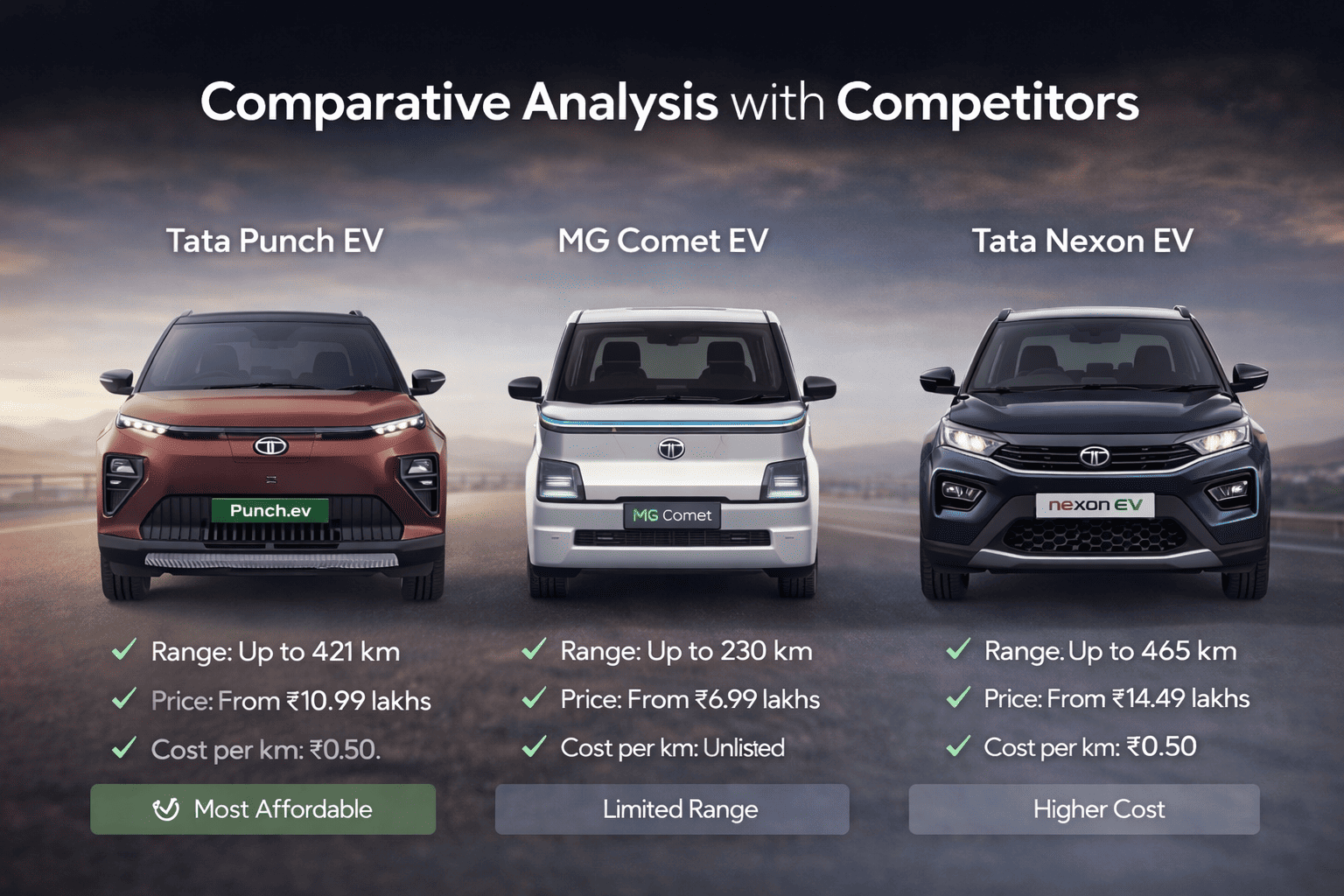
The Tata Punch EV faces competition from both hatchback-style EVs and compact electric SUVs.
Punch EV vs. Citroen eC3
The Citroen eC3 is the most direct competitor in the sub-₹15 lakh bracket. While the eC3 offers a more comfortable, “magic carpet” ride quality and a slightly longer wheelbase, it falls short on technological features and safety equipment. The eC3 uses an air-cooled 29.2 kWh battery, which is generally considered less efficient at handling high-speed charging heat than the liquid-cooled system in the Punch EV.
Punch EV vs. MG Windsor EV
The MG Windsor EV is a larger crossover that offers significantly more interior space and a premium glass roof. However, the Windsor EV is also priced higher, with top-end variants reaching ₹18.50 Lakh. The Punch EV remains the more viable choice for those who prioritize a compact footprint for city navigation and a higher ground clearance for rough roads.
Feature
Tata Punch EV (LR)
Citroen eC3
MG Windsor EV
Battery Size
35 kWh
29.2 kWh
38 kWh
Motor Power
122 hp
57 hp
134 hp
Torque
190 Nm
143 Nm
200 Nm
Real-World Range
~260 km
~210 km
~280 km
Safety Rating
5 Star (BNCAP)
0 Star (GNCAP)
5 Star (BNCAP)
Data compiled from.
Local Availability: Malappuram and Kozhikode Showrooms
For readers of nuhmanareekode.com, local availability and after-sales support are paramount. Tata Motors has established a robust dealership network in Northern Kerala to support the new Punch EV launch.
Luxon Tata, Areekode: Ground Floor, Mukkam Road, Thekkinchuvadu. Near Bharath Car Wash. Contact: +91 8879076009.
These showrooms provide a dedicated EV sales and service experience, with charging facilities often available for customers.
The Future Outlook: Challenges and Opportunities
The trajectory for the Tata Punch EV in 2026 is one of growth, but it is not without hurdles. The Union Budget 2026-27 has shifted focus towards supply-side maturity, focusing on the “Rare Earth Corridor” in states like Kerala to manufacture indigenous EV motors and magnets, which could eventually lead to further price reductions.
However, “range anxiety” remains a psychological barrier. While the government has released over ₹2,000 crore for public charging infrastructure through schemes like PM E-DRIVE, the density of chargers in rural Kerala still lags behind urban centers like Ernakulam or Thiruvananthapuram. Furthermore, as EV penetration increases, states like Karnataka have already begun reintroducing road taxes, a trend that may eventually reach Kerala, thereby affecting the initial affordability of these vehicles.
Conclusions
The 2026 Tata Punch EV Facelift is a pivotal product that successfully bridges the gap between affordable urban mobility and premium electric vehicle features. Its foundation on the acti.ev architecture provides it with a structural and safety advantage that is currently unmatched in the sub-₹15 lakh segment. With a 5-star Bharat NCAP rating and a real-world range that comfortably covers the daily needs of over 90 percent of Indian commuters, it is the definitive choice for those looking to transition from internal combustion to electric.
For the residents of Kochi, Malappuram, and the surrounding regions, the Punch EV offers a unique combination of high ground clearance, premium tech, and incredibly low running costs. While the “800 km range” remains a distant target for the industry at large, the 2026 Punch EV delivers exactly what is required for the Indian road: a robust, safe, and economically viable SUV that does not compromise on performance or style. As Tata Motors continues to expand its service network and the national charging infrastructure grows, the Punch EV is well-positioned to remain the market leader throughout 2026 and beyond.


 The Sacred Connection: Ramadan and the Quran
 The Sacred Connection: Ramadan and the Quran
 Why Listening is as Important as Reading
 Elevate Your Ramadan Experience
 Why Checking Tomorrow’s Weather Matters More Than You Think
 How to Read a Weather Forecast Like a Pro
 Preparing for Tomorrow’s Weather: Practical Tips
 Malappuram Ramadan Calendar 2026 (Tentative)
 Why 20 Rakats?
 Essential Deeds During the Month
 Global vs. Indian Level: TradingView vs. MCX
 How to Evaluate Current Value: The Investor’s Checklist
 FAQ: Your Top Questions Answered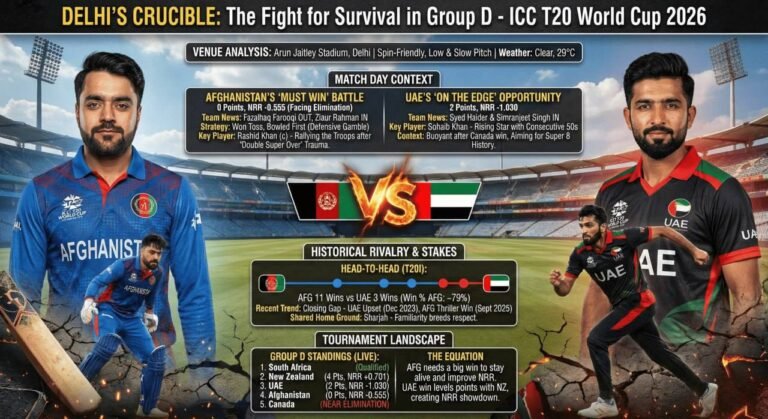
 The Tournament Landscape and Pre-Match Context (AFG vs UAE T20)
 Historical Rivalry and Geopolitical Dynamics
 Venue Analysis – The Arun Jaitley Stadium (AFG vs UAE T20)
 Match Day – Team News and Tactical Shifts (AFG vs UAE T20)
 Aesthetic Evolution and Exterior Design Philosophy
 Performance, Battery, and Charging Dynamics
 Comparative Analysis with Competitors