
A Crucible of Ambition and Despair in Delhi
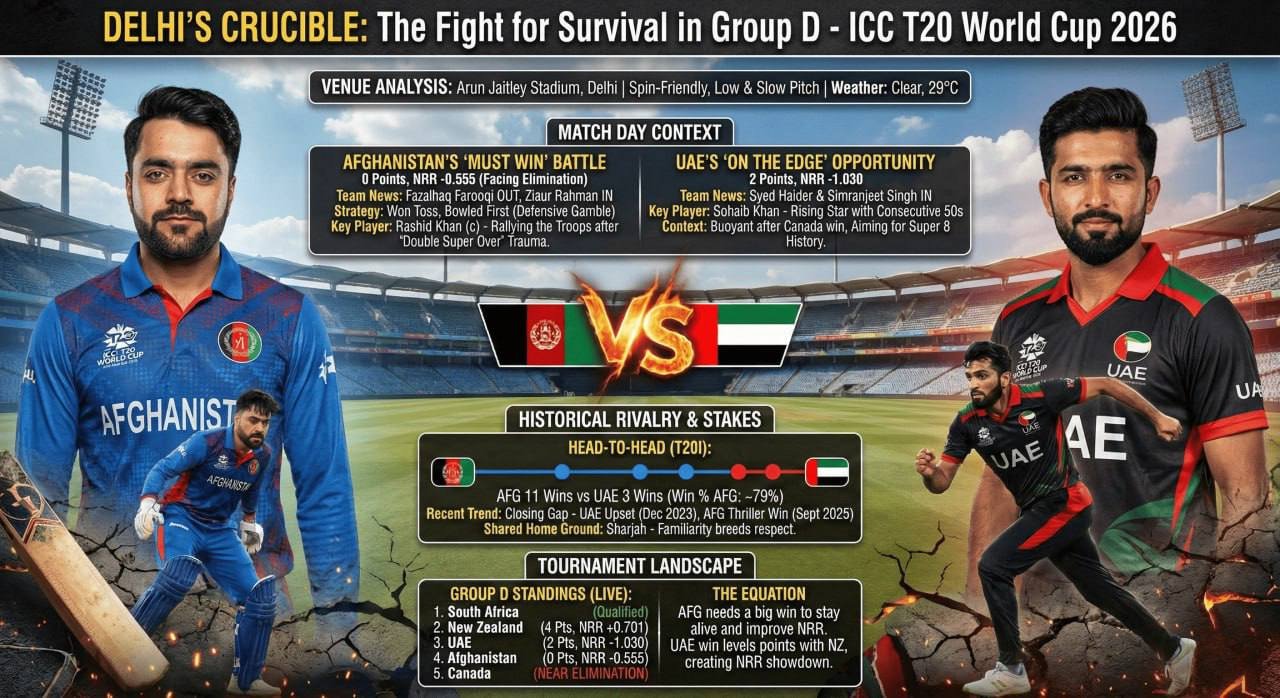
AFG vs UAE T20 On the morning of February 16, 2026, the Arun Jaitley Stadium in New Delhi became the epicenter of a frantic struggle for survival in Group D of the ICC Men’s T20 World Cup. The contest between Afghanistan and the United Arab Emirates (UAE) was not merely a scheduled fixture in the global cricketing calendar; it was a collision of two diverging narratives within the Asian cricketing ecosystem. For Afghanistan, a Full Member nation with a semi-final pedigree from the 2024 edition, the tournament had curdled into a sequence of heartbreaks and near-misses. Sitting winless after two matches, including a historic and psychologically devastating “Double Super Over” loss to South Africa, Rashid Khan’s men entered the arena with their World Cup dreams hanging by a thread. Conversely, the UAE arrived with the buoyant energy of a rising Associate power, fresh from a gritty victory over Canada that validated their developmental structures and placed them in genuine contention for a Super 8 berth.
This comprehensive report provides an exhaustive analysis of Match 28 (AFG vs UAE T20), dissecting the pre-match geopolitical and sporting context, the psychological baggage carried by the Afghan squad, and the tactical nuances of the encounter itself. Through a detailed reconstruction of the first innings, analyzing ball-by-ball data and player performance, we explore how Afghanistan attempted to stifle a spirited Emirati lineup despite the absence of their premier pacer, Fazalhaq Farooqi. Furthermore, we examine the broader implications of this rivalry, which mirrors the shifting tectonic plates of cricket in the Middle East and South Asia.
 The Tournament Landscape and Pre-Match Context (AFG vs UAE T20)
 The Tournament Landscape and Pre-Match Context (AFG vs UAE T20)
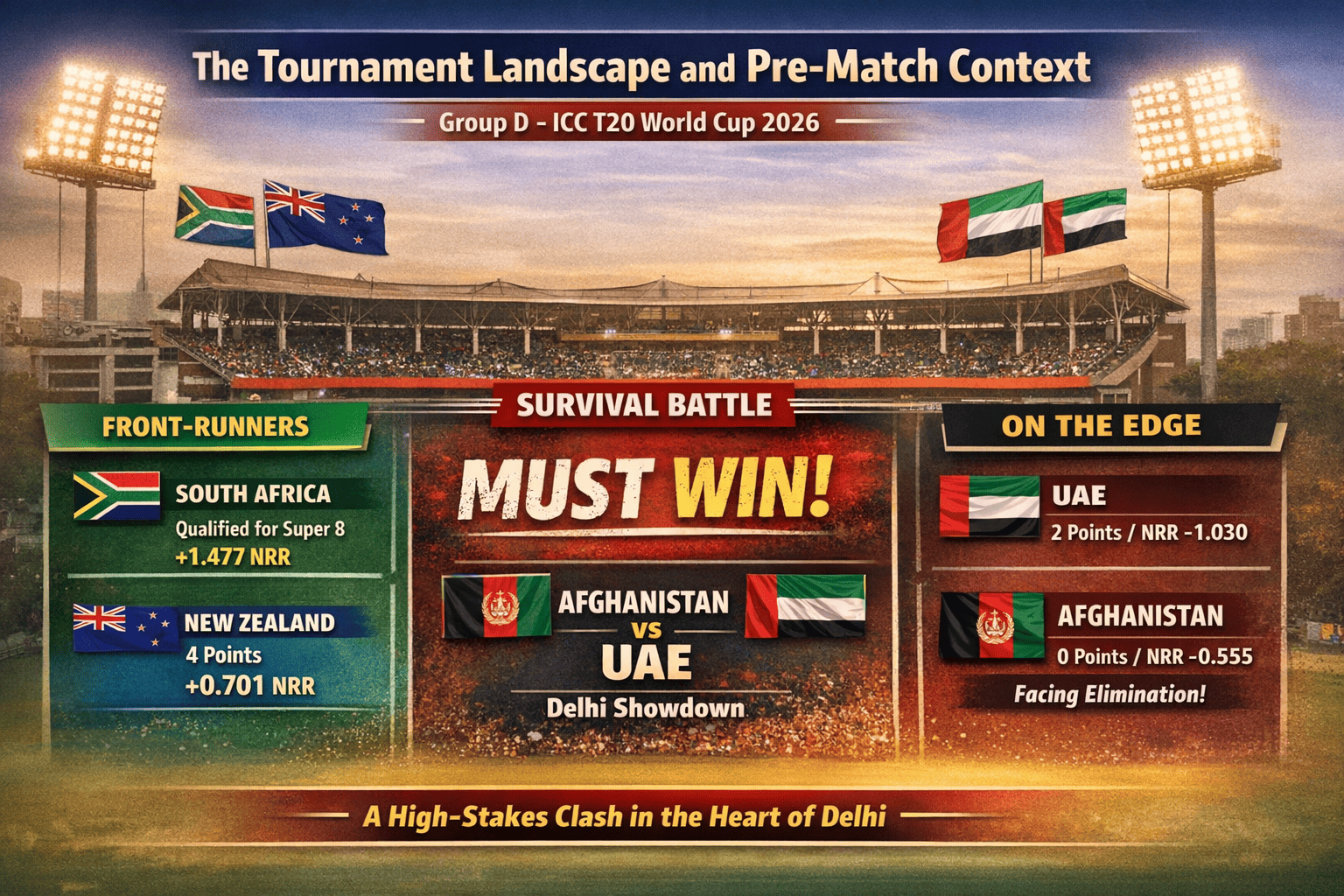
To understand the ferocious intensity of this Monday morning clash, one must first navigate the turbulent waters of Group D, arguably the “Group of Death” for the Associate nations involved. The stakes in Delhi were defined not just by the points on offer but by the mathematical precipice both teams faced.
The Group D Arithmetic: Survival of the Fittest
As the sun rose over the hazy skyline of the Indian capital, the Group D standings painted a stark picture of disparity and desperation. South Africa had already stamped their authority on the group, securing qualification for the Super 8s with three consecutive victories and a formidable Net Run Rate (NRR) of +1.477. This left only one automatic qualification spot available, with New Zealand holding the prime position on 4 points.
The equation for the chasing pack was unforgiving:
New Zealand (4 points, NRR +0.701): Sitting comfortably but not safely. A slip-up could open the door.
UAE (2 points, NRR -1.030): Occupying the third spot. A win against Afghanistan would elevate them to 4 points, level with the Black Caps, creating a high-pressure scenario where NRR would decide the second qualifier.
Afghanistan (0 points, NRR -0.555): The 2024 semi-finalists found themselves in the unfamiliar territory of the wooden spoon battle. To stay alive, they required not just a win, but a comprehensive one to repair their NRR and bridge the gap to New Zealand.
For Afghanistan, the match against the UAE was a de facto knockout game. A loss would mathematically eliminate them from Super 8 contention, rendering their final group game against Canada a dead rubber—a humiliating prospect for a team that had established itself as a top-tier T20 outfit.
The Psychological Baggage: Afghanistan’s “Double Super Over” Trauma
The mental state of the Afghan squad entering this match cannot be overstated. Just days prior, they had participated in a match that defied the conventions of the sport and pushed the physical limits of the players involved. The encounter against South Africa at the Narendra Modi Stadium in Ahmedabad will go down in history as the “Match of the Century,” but for the Afghan players, it remains a scar.
The details of that match provide the context for the tension visible in Delhi:
The Tie: Chasing a formidable 187, Afghanistan was powered by a gladiatorial knock of 84 off 42 balls from Rahmanullah Gurbaz, tying the game on the final ball.
Super Over 1: In a display of nerve-shredding parity, both teams scored exactly 17 runs in the first Super Over.
Super Over 2: The unprecedented second Super Over saw South Africa plunder 23 runs. Afghanistan responded with 19, falling agonizingly short by 4 runs.
This defeat was more damaging than a thrashing. It eroded the team’s belief in their ability to close out tight games. The physical fatigue of a double-over thriller, combined with the emotional crash of coming so close yet failing, created a “hangover” effect. Questions swirled about their resilience: Could Gurbaz recover from the heartbreak of his heroic failure? Could Rashid Khan rally a troop that felt the universe was conspiring against them? The Delhi match was their opportunity to answer these questions, to exorcise the ghosts of Ahmedabad.
The Emirati Ascendancy: A Narrative of Belief
While Afghanistan licked its wounds, the UAE camp was surging with a newfound belief. Their tournament had begun disastrously with a 10-wicket demolition by New Zealand, a result that threatened to confirm the skepticism surrounding Associate nations at major events. However, their response against Canada was a masterclass in resilience.
The victory over Canada was significant not for the margin (5 wickets) but for the manner in which it was achieved. It was not a victory dependent on their talismanic captain, Muhammad Waseem. Instead, it was engineered by two young, India-born talents who had found a cricketing home in the Emirates:
Aryansh Sharma: The wicketkeeper-batter anchored the chase with an unbeaten 74 off 53 balls, displaying a maturity that belied his age.
Sohaib Khan: His explosive 51 off 29 balls provided the necessary acceleration, proving that the UAE batting lineup possessed depth and power beyond the top order.
This win did more than put points on the board; it validated the UAE’s high-performance program and the impact of the International League T20 (ILT20). Players like Junaid Siddique, who claimed a five-wicket haul against Canada, looked comfortable on the big stage, having rubbed shoulders with the world’s best in franchise cricket. They arrived in Delhi not as underdogs hoping for a miracle, but as competitors expecting to win.
Historical Rivalry and Geopolitical Dynamics
 Historical Rivalry and Geopolitical Dynamics
The clash between Afghanistan and the UAE (AFG vs UAE T20) is layered with history that extends beyond the boundary rope. It is a rivalry rooted in the shared geography of cricket’s development in the Middle East and the complex brotherhood of two nations whose cricketing paths have been intertwined for decades.
The “Home” Away from Home
For years, the UAE served as the adopted home of Afghan cricket. Exiled by war and instability, Afghan players honed their skills on the concrete wickets of refugee camps in Pakistan but played their international cricket in the grand stadiums of Sharjah, Dubai, and Abu Dhabi. The Emirates Cricket Board (ECB) hosted Afghanistan for years, providing the infrastructure that allowed the “Blue Tigers” to rise from Division 5 of the World Cricket League to Full Member status.
This history creates a unique dynamic. The Afghan players know the UAE conditions—and often the UAE players—intimately. However, for a long time, the relationship was hierarchical: Afghanistan was the big brother, the success story, while the UAE remained the stagnant Associate.
The Closing Gap: Head-to-Head Analysis
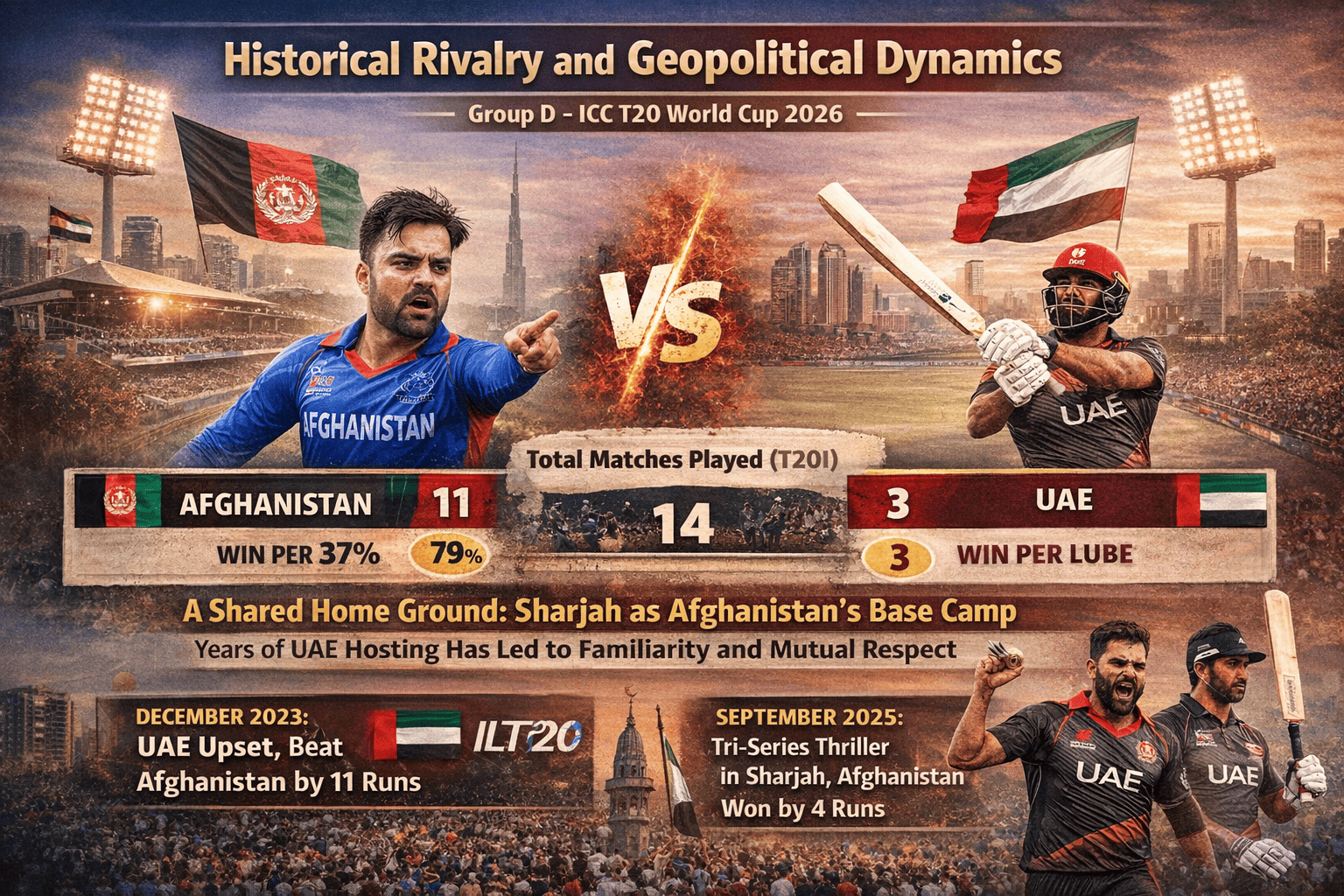
The statistics reflect Afghanistan’s historical dominance, but a closer look reveals a tightening contest.
Total Matches Played (T20I): 14
Afghanistan Wins: 11
UAE Wins: 3
Win Percentage (AFG): ~79%.
However, the “Associate gap” has been shrinking rapidly in the 2023-2025 cycle.
December 2023: UAE defeated Afghanistan by 11 runs in a T20I, a shock result that signaled their rising competence.
September 2025: In a T20I Tri-Series in Sharjah, Afghanistan won by a mere 4 runs, defending 170 in a nail-biter that went down to the final ball.
Competitive Trend: While Afghanistan leads 4-1 in the last five encounters, the margins of victory have decreased. The days of Afghanistan rolling over the UAE for sub-100 scores are largely gone. The UAE batters, exposed to high-quality spin in the ILT20, are no longer “bamboozled” by mystery spin in the way they were a decade ago.
The ILT20 Effect
The emergence of the ILT20 (International League T20) in the UAE has been a catalyst for this shift. Local UAE players are now mandated to be part of the playing XIs in the league, forcing them to compete against and alongside elites like Trent Boult, Andre Russell, and indeed, Rashid Khan and Fazalhaq Farooqi. This exposure has demystified the “superstar” aura of the Afghan players. When Sohaib Khan faces Rashid Khan in Delhi, he is facing a bowler he has likely analyzed, played against, or even shared a dressing room with in the franchise circuit.
Venue Analysis – The Arun Jaitley Stadium (AFG vs UAE T20)
 Venue Analysis – The Arun Jaitley Stadium (AFG vs UAE T20)
The stage for this drama was the Arun Jaitley Stadium (formerly Feroz Shah Kotla) in New Delhi. Historically one of India’s oldest grounds, it possesses a unique character that significantly influences team selection and tactics.
Pitch Characteristics: The Spinner’s Paradise?
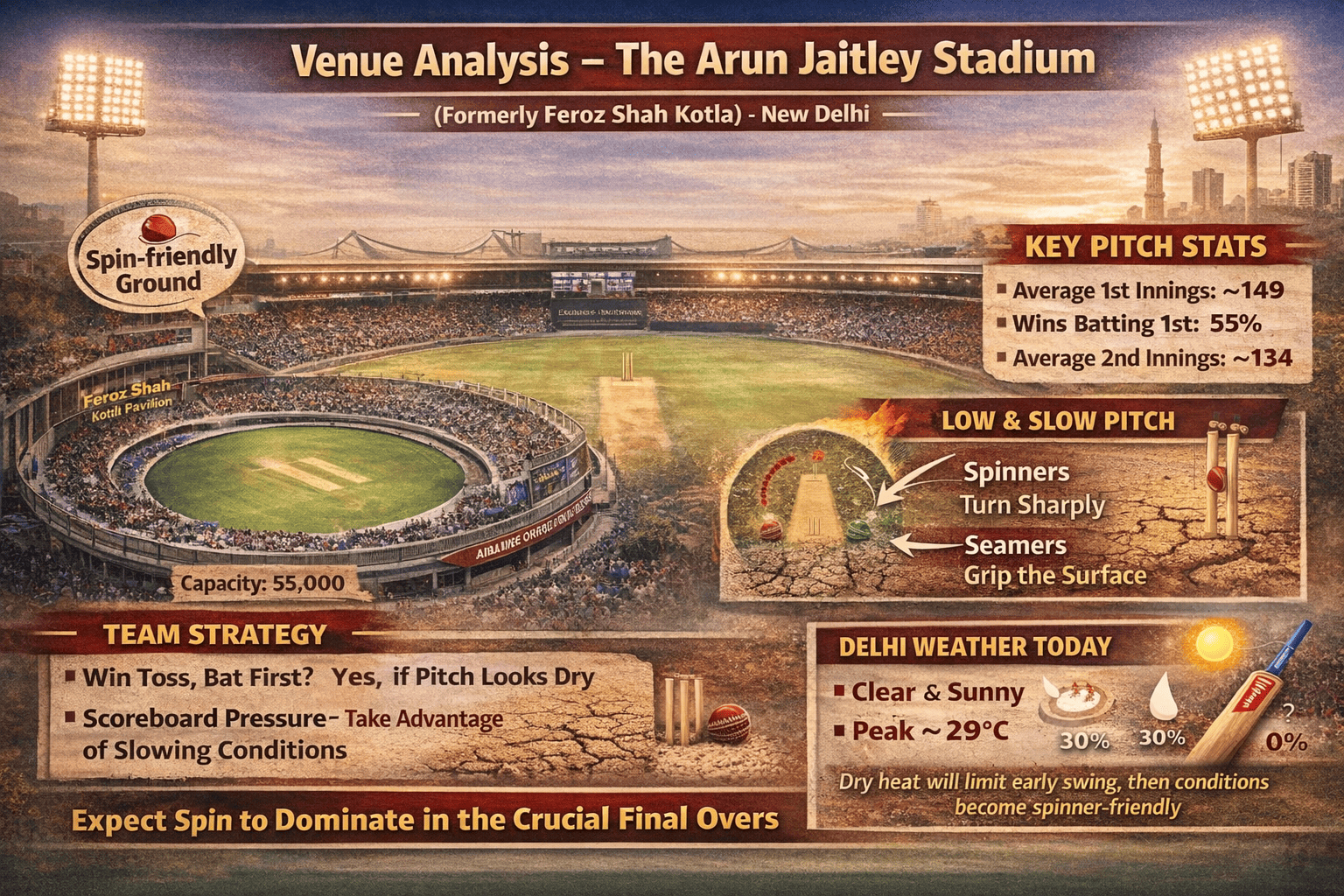
Traditionally, the Delhi pitch is low and slow, favoring spinners and cutters. The soil composition often leads to the wicket breaking up as the game progresses, making stroke-making difficult in the latter half of the second innings.
Average 1st Innings Score: ~149.
Average 2nd Innings Score: ~134.
Key Stat: Teams winning the toss often prefer to chase in T20s to gauge the target, but at the Kotla, batting first and putting runs on the board (scoreboard pressure) is a viable strategy if the pitch is particularly dry.
However, recent IPL seasons and the 2023 ODI World Cup showed a different side to Delhi—flatter tracks with smaller boundaries leading to high scores. The uncertainty of which “version” of the pitch would appear added a layer of intrigue to the toss.
Weather Conditions
The forecast for February 16, 2026, was quintessential Delhi winter-spring transition:
Temperature: Peak of 29°C.
Sky: Clear and sunny.
Humidity: Moderate.
Rain Probability: 0%. The dry heat and lack of cloud cover meant that swing would be limited to the very early overs, after which the spinners would dictate proceedings. The absence of dew (being a day game) meant the captains did not have to worry about the ball getting wet in the second innings.
Match Day – Team News and Tactical Shifts (AFG vs UAE T20)
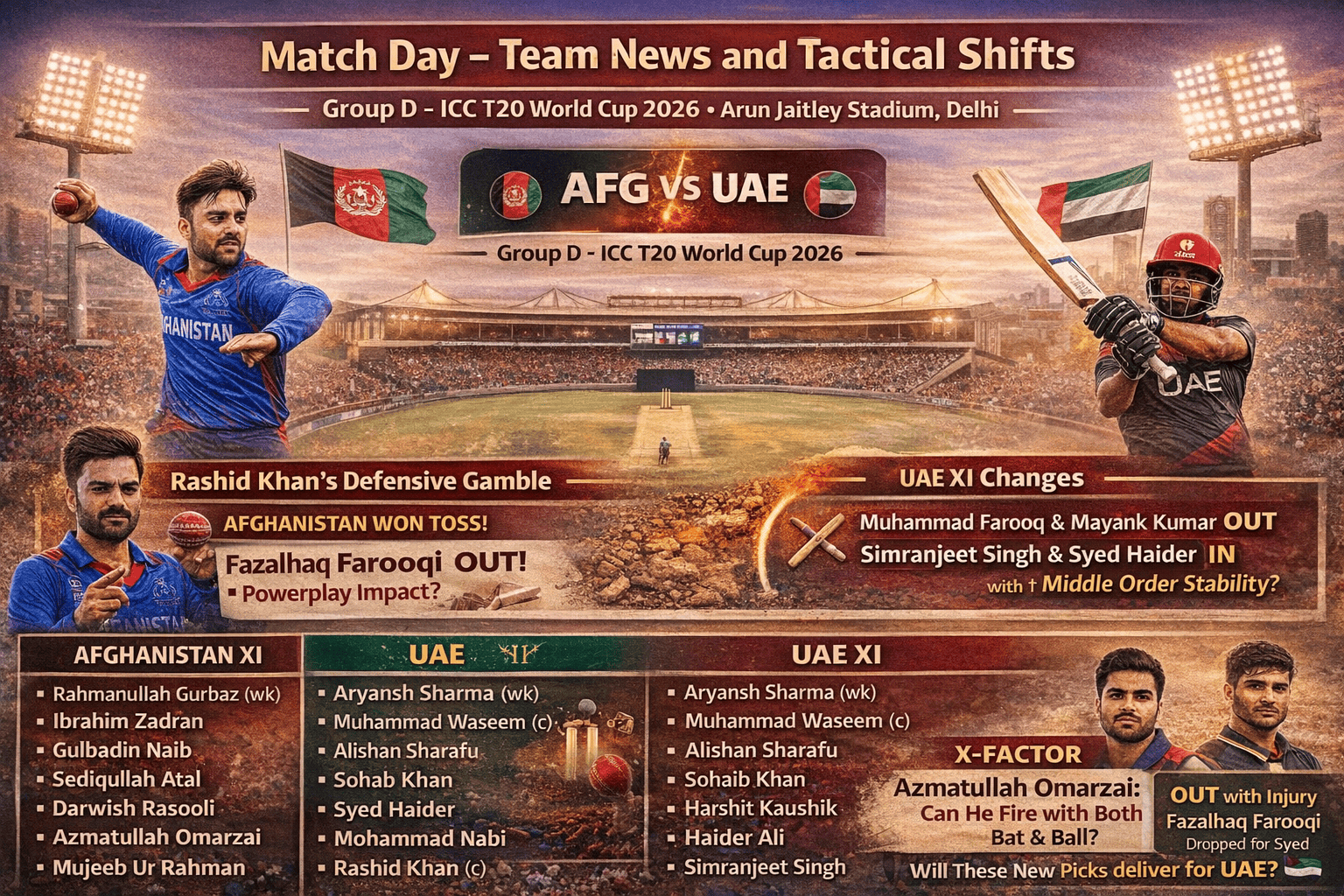 Match Day – Team News and Tactical Shifts (AFG vs UAE T20)
As the captains walked out for the toss at 10:30 AM IST, the atmosphere was tense. The stands were filling up, largely with Afghan students and expatriates living in Delhi, creating a partisan atmosphere that effectively made this a home game (AFG vs UAE T20) for Afghanistan.
The Toss: Rashid’s Defensive Gamble
Rashid Khan won the toss and elected to bowl first.
The Rationale: This decision was defensive. Coming off the trauma of the South Africa match, where they failed to defend/tie in the Super Over, Rashid likely wanted to control the controllables. By bowling first, he could unleash his spinners on a fresh-ish wicket and chase a known target, removing the anxiety of setting a total.
UAE’s Perspective: UAE captain Muhammad Waseem admitted he would have batted first as well, hoping to put runs on the board and let the pressure of the chase weigh on the fragile Afghan batting lineup.
Team News: The Farooqi Blow
The headline news from the toss was a significant setback for Afghanistan. Fazalhaq Farooqi, their premier left-arm pacer and arguably the best new-ball bowler in the tournament, was ruled out of the playing XI.
Impact: Farooqi is the linchpin of Afghanistan’s powerplay strategy. His ability to swing the ball back into right-handers and hold a tight line is crucial. Without him, the attack lacked its spearhead.
Replacement: Ziaur Rahman Sharifi was drafted in. Ziaur is a different type of bowler—hit-the-deck hard, relying on seam movement rather than swing. While a capable replacement, he lacks Farooqi’s terror factor.
Afghanistan Playing XI:
Rahmanullah Gurbaz (wk)
Ibrahim Zadran
Gulbadin Naib
Sediqullah Atal
Darwish Rasooli
Azmatullah Omarzai
Mohammad Nabi
Rashid Khan (c)
Mujeeb Ur Rahman
Noor Ahmad
Ziaur Rahman.
UAE Playing XI:
Aryansh Sharma (wk)
Muhammad Waseem (c)
Alishan Sharafu
Sohaib Khan
Syed Haider (In for Mayank Kumar)
Harshit Kaushik
Muhammad Arfan
Haider Ali
Simranjeet Singh (In for Muhammad Farooq)
Junaid Siddique
Muhammad Jawadullah.
The UAE made two changes, bringing in Syed Haider and Simranjeet Singh, likely to bolster their middle-order batting against spin and add a spin option of their own.
The First Innings – A Tactical Autopsy
The first innings was a fascinating study in momentum swings, showcasing the gap in experience between the two sides. While the UAE showed flashes of brilliance, Afghanistan’s ability to take wickets at critical junctures kept them in control.
The Powerplay: Omarzai Fills the Void (Overs 1-6)
With Farooqi missing, the pressure was on Azmatullah Omarzai to deliver with the new ball. He did not disappoint.
0.4 Overs: In the very first over, Omarzai struck a massive blow. Aryansh Sharma, the hero of the Canada win, was trapped for a duck (0 off 4 balls).
Analysis: Sharma is the anchor of the UAE innings. Removing him before he could settle exposed the middle order immediately. It was a perfect start for Afghanistan, calming the nerves after the toss.
2.0 Overs: The UAE captain, Muhammad Waseem, known for his explosive hitting, tried to counter-attack. He scored a quick 10 off 6 balls, including two boundaries, but his aggression was his undoing. Facing the mystery spin of Mujeeb Ur Rahman, Waseem was trapped LBW.
Score at 2.0 Overs: 13/2.
At this stage, the UAE was staring down the barrel. Losing both openers inside 2 overs is often a death knell in T20 cricket, especially against a team with the bowling depth of Afghanistan. The Afghan fans in the stadium roared, sensing a quick rout.
The Resistance: Sharafu and Sohaib Khan (Overs 3-11)
Just as a collapse seemed imminent, the UAE found resilience in the form of Alishan Sharafu and Sohaib Khan.
Stabilizing the Ship: The pair eschewed risky shots initially, focusing on rotating the strike against Ziaur Rahman and Naveen-ul-Haq (Note: Naveen is listed in some squads, but Ziaur played; the text confirms Ziaur bowled).
Counter-Attack: Once settled, they began to attack. Sohaib Khan, continuing his form from the Canada match, took the attack to the spinners. He used his feet well against Noor Ahmad, disrupting the spinner’s length.
The Partnership: They constructed a vital stand of 84 runs. This partnership brought the UAE back into the game, pushing the score past 90 and setting a platform for a 160+ total.
The Turning Point: Mujeeb’s Return (Overs 11-12)
Cricket is a game of moments, and the 12th over was the defining moment of the innings. Rashid Khan brought Mujeeb Ur Rahman back into the attack to break the stand.
11.2 Overs: Mujeeb tossed one up, enticing Sharafu into a big shot. Sharafu backed away to hit over long-off but failed to get the elevation. Ibrahim Zadran took a comfortable catch near the boundary.
Dismissal: Alishan Sharafu c Ibrahim Zadran b Mujeeb Ur Rahman 40 (31 balls).
Score: 97/3.
This wicket was the catalyst for the second collapse. Sharafu was the set batter who could have accelerated at the death. His dismissal exposed the lower-middle order to the high-pressure death overs.
The Middle-Order Slide (Overs 13-16)
Following Sharafu’s departure, the Afghan bowlers tightened the noose.
Syed Haider’s Cameo: The new man, Syed Haider, tried to keep the momentum going. He struck a six and a four in a brief stay of 13 runs off 10 balls, but was cleaned up by the returning Azmatullah Omarzai.
Double Strike: In the same spell, Omarzai removed Harshit Kaushik for a duck (0 off 3 balls), caught by Gurbaz.
The Hit Wicket: The pressure exerted by Rashid Khan resulted in a comical yet tragic dismissal for UAE. Muhammad Arfan, attempting to improvise a reverse sweep against the Afghan captain, lost his balance and stepped onto his stumps. Hit Wicket b Rashid Khan 0 (2 balls).
State of Play at 16.0 Overs
As the match headed into the final four overs, the scorecard read:
Score: 121/6.
Run Rate: 7.56.
Key Batter: Sohaib Khan was still at the crease, batting beautifully on 53 off 38 balls*.
Bowling Figures:
Azmatullah Omarzai: 3 wickets for 10 runs (3.0 overs) – A match-winning spell.
Mujeeb Ur Rahman: 2 wickets for 31 runs (4.0 overs).
Rashid Khan: 1 wicket for 24 runs (4.0 overs).
The UAE had squandered a brilliant platform. From 97/2, they had lost 4 wickets for just 24 runs. The projected score dropped from 170 to a scrappy 145-150.
Statistical Deep Dive and Player Performance
The first innings provided a wealth of statistical insights that highlight the strengths and weaknesses of both sides.
Azmatullah Omarzai: The Silent Assassin
While Rashid Khan and Mujeeb grab the headlines, Azmatullah Omarzai has quietly become Afghanistan’s most valuable asset in conditions that offer a hint of movement.
Spell Analysis: His 3/10 included the prize wicket of Aryansh Sharma and two middle-order scalps that halted the UAE charge.
Milestone: With the wicket of Sharma, Omarzai reached his 50th T20I wicket, a testament to his consistency.
Tactical Importance: By taking wickets with the old ball (overs 14-15), he solved Afghanistan’s chronic death-bowling issue, usually a vulnerability when Farooqi is absent or bowled out early.
Sohaib Khan: The UAE’s New Star
Sohaib Khan’s innings of 53* (at the 16-over mark) was a masterclass in controlled aggression.
Consistency: This was his second consecutive 50+ score, following his 51 vs Canada.
Technique: His ability to sweep the spinners and hit down the ground against the pacers showed a complete game.
Significance: In a team often reliant on Waseem, Sohaib has emerged as the reliable middle-order pivot. His wagon wheel (inferred) showed strength in the ‘V’ and the sweep zone, making it hard for Rashid to set a field.
Mujeeb Ur Rahman: The Partnership Breaker
Mujeeb’s figures of 2/31 might look expensive compared to Omarzai, but his impact was arguably equal.
Economy vs Impact: He went for 7.75 runs per over, but he took the wickets of the two set batters (Waseem and Sharafu). In T20 cricket, breaking a partnership is often worth 20 runs.
Variations: He used his carrom ball effectively to confuse the right-handers, forcing the false shot from Sharafu.
Qualification Scenarios and Future Outlook In Light Of (AFG vs UAE T20)
As the match progresses into the second innings, the implications for the Group D table are massive.
Current Live Standings (Group D):
| Team | Played | Won | Lost | Points | NRR | Status |
| South Africa | 3 | 3 | 0 | 6 | +1.477 | Qualified |
| New Zealand | 3 | 2 | 1 | 4 | +0.701 | In Contention |
| UAE | 2 | 1 | 1 | 2 | -1.030 | In Contention |
| Afghanistan | 2 | 0 | 2 | 0 | -0.555 | Critical |
| Canada | 2 | 0 | 2 | 0 | -1.526 | Near Elimination |
Afghanistan Chases Successfully
If Afghanistan chases down the target (likely ~150):
Points: They move to 2 points, level with the UAE (and potentially Canada if they lose their next game).
NRR Implication: A quick chase (e.g., in 16-17 overs) would significantly boost their NRR, possibly overtaking UAE and moving closer to New Zealand’s +0.701.
Outlook: They would stay alive. They would then need to beat Canada in their final game and hope New Zealand loses to the UAE or that run-rate math works in their favor.
UAE Defends the Total
If the UAE wins:
Points: They move to 4 points, level with New Zealand.
Outlook: This would be a seismic result. Afghanistan would be eliminated. UAE would be in a prime position to qualify for the Super 8s, needing only to avoid a heavy defeat in their final game (or win it) to potentially knock out New Zealand on NRR or points.
History: It would mark the first time an Associate nation from the Middle East qualified for the Super 8 stage of a T20 World Cup, validating the expansion of the game.
Second Innings Preview – The Chase
The stage is set for a thrilling chase. Afghanistan needs approximately 150 runs to stay in the World Cup.
The Key Battle: Rahmanullah Gurbaz vs Junaid Siddique. Gurbaz is the aggressor; Siddique is the wicket-taker (5-fer vs Canada). The first 6 overs will decide the game. If Siddique removes Gurbaz early, the panic in the Afghan camp—stemming from the South Africa loss—will be palpable.
The Spin Factor: The UAE has a capable spin attack. Can they utilize the drying Delhi pitch to strangle the Afghan middle order like Afghanistan did to them?
Verdict: Afghanistan enters the break as favorites due to their batting depth and experience, but the “scoreboard pressure” of a must-win game can do strange things to even the best teams.
A Watershed Moment
Regardless of the final result, Match 28 of the 2026 T20 World Cup will be remembered as a pivotal moment in the history of Asian cricket. For Afghanistan, it is a test of character—can they bounce back from the lowest point (the SA loss) to keep their dreams alive? For the UAE, it is a statement of intent—proving that they are no longer just the hosts of cricket, but serious competitors on the field.
The Arun Jaitley Stadium, with its history of witnessing cricketing attrition, provided the perfect backdrop for this struggle. As the players walked off after the first innings, the game was poised on a knife-edge: Afghanistan holding the upper hand tactically, but UAE holding the psychological card of having nothing to lose and everything to gain.
Read More About (AFG vs UAE T20)…



Comments are closed.